- This topic is empty.
-
AuthorPosts
-
14/08/2026 at 16:59 #81982
Parallel operation is a control problem wearing a hardware disguise. Two sources that both want to set voltage and frequency will fight unless something arbitrates, and the quality of that arbitration determines whether the pairing saves fuel or simply adds an expensive box to the site.
What follows is a technical view of the interface, the modes it has to support, and how to test it before the equipment ships.
What “Parallel” Has to Mean in Practice
Three arrangements are commonly described as parallel operation, and they place very different demands on the equipment.
Sequential handover
The generator set runs, charges the battery, then stops. The battery carries the load alone. Only one source is live at any moment, so the technical requirement is a clean transfer rather than true parallel running.
True parallel with load sharing
Both sources supply the load simultaneously, sharing it according to a control rule. This requires synchronisation, matched voltage and frequency, and an agreed division of real and reactive power.
Battery as peak absorber
The generator set carries the base load continuously while the battery supplies transient peaks and motor-start inrush. This is parallel running with an asymmetric rule, and it is the arrangement that most often justifies a smaller generator.
Most site enquiries describe the first and specify the second. Establishing which is actually wanted removes a large amount of downstream confusion.
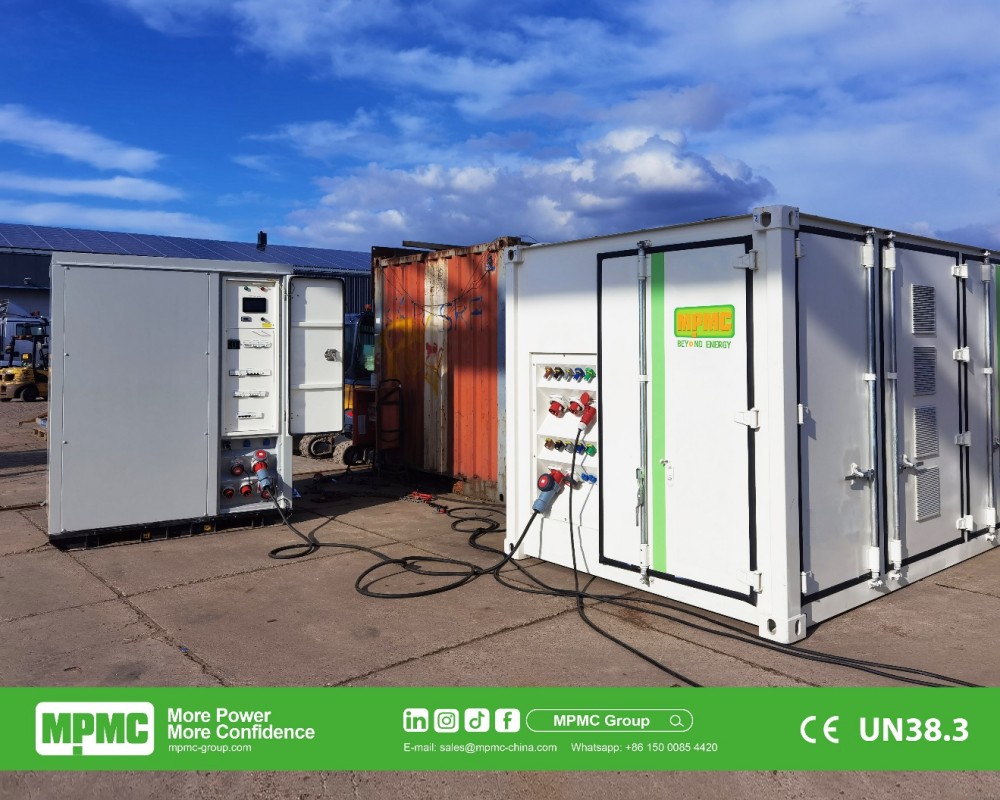
HBD-R units are supplied to operate in parallel with generator sets in hybrid rental configurations.
The Control Handshake
Four exchanges have to work for an automatic cycle to run unattended.
State of charge to the generator controller. The controller needs to know when to start. Without this signal, starting is either manual or on a fixed timer, which wastes fuel.
Load demand to the battery EMS. The battery needs to know how much of the load it is expected to carry, and when to stop discharging so that the generator can take over cleanly.
Synchronisation before closing. Where both sources will be live together, voltage, frequency and phase must match before the breaker closes.
Fault and shutdown propagation. A fault on either side must be visible to the other. A battery that keeps supplying into a fault the generator has already isolated is a safety problem.
MPMC lists HBD-R compatibility with DSE, ComAp, DEIF, Woodward, Smartgen and CAT EMCP controllers, which are the brands these exchanges are normally implemented against. The specific controller model in use should be named and confirmed rather than inferred from the brand list.
Transfer Behaviour and What Trips
The moment of transfer is where sensitive equipment reveals itself.
Transfer type
What happens
What tolerates it
What does not
Gap transfer
A brief interruption while one source disconnects and the other closes
Lighting, welfare, heating, most tools
Servers, control systems, some VFDs
Seamless transfer
Sources synchronise and load moves without interruption
Everything
Requires the capability to be specified
MPMC lists seamless on-grid and off-grid switching as standard on the HBD-R series. Where the site has equipment that will trip on a short interruption, this needs to be written into the specification rather than assumed from a product family.
Sizing for Peak Absorption
Where the battery is bought to absorb transients, the sizing calculation is different from an energy calculation.
The figure that matters is the inrush, not the running load. A tower crane, concrete pump, or large motor draws several times its running current at start, and it is that peak that the battery has to cover if the generator set is not to be sized for it.
MPMC describes the HBD-R series as providing millisecond-level transient load smoothing. The practical checks are the battery’s peak power capability, its duration at that peak, and the recovery time before the next start.
The prize is generator downsizing. A set specified for a peak that occurs a handful of times per shift spends the rest of its life running lightly loaded, which MPMC’s materials identify as the condition where fuel consumption per kWh rises and engine condition deteriorates.
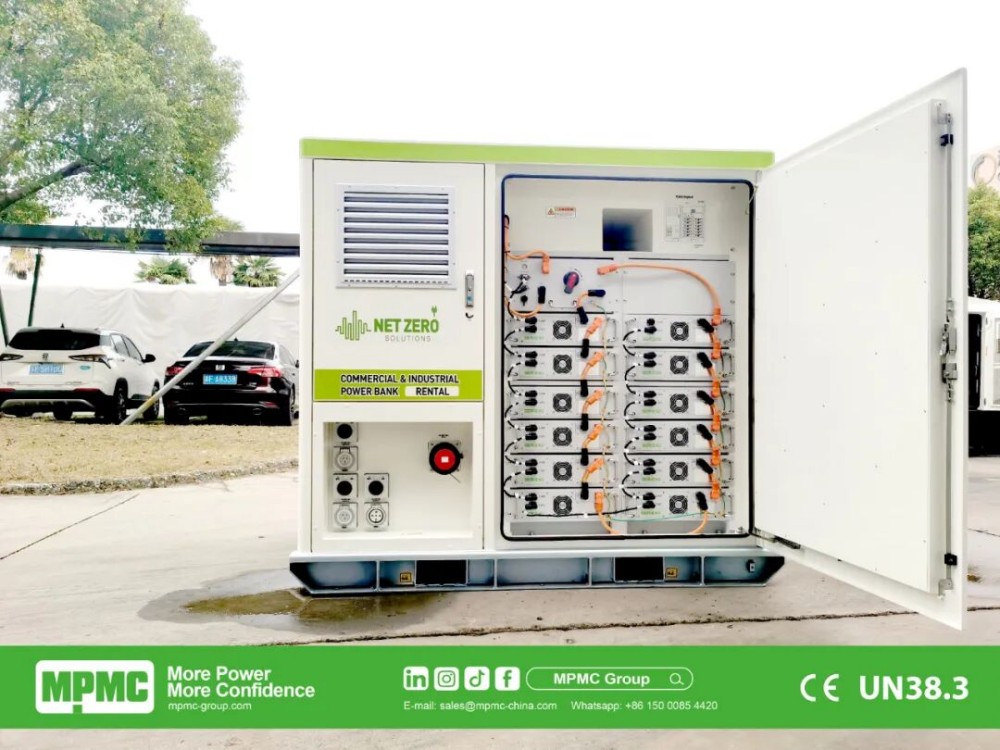
MPMC HBD-R series energy storage system
The MPMC HBD-R Range
Model
Continuous AC power
System energy at 25°C
Battery pack
Cooling
HBD-30-60
30 kW
61.44 kWh
100 Ah LFP
HVAC
HBD-50-100
50 kW
112.5 kWh
314 Ah LFP
HVAC
HBD-100-200
100 kW
225.1 kWh
314 Ah LFP
HVAC
HBD-200-200
200 kW
203.5 kWh
265 Ah LFP
LCAC
HBD-250-400
250 kW
450.2 kWh
314 Ah LFP
HVAC
HBD-400-400
400 kW
407 kWh
265 Ah LFP
LCAC
HBD-610-610
610 kW
610.6 kWh
265 Ah LFP
LCAC
MPMC lists 6,000 cycles at 90% depth of discharge across the series, an operating range of −20°C to +50°C, PowerLock and CEE plug-and-play connections, and remote monitoring via EMS with 4G or 5G. The PCS is listed as PWS2-30P-EX on smaller models and PWS1-135M on larger ones.
Note the 265 Ah cell models. MPMC identifies these as the 1C R-series configuration with liquid cooling, which is what supports higher power from a given energy capacity. Where the requirement is peak absorption rather than duration, these are the models to review.
Testing the Pairing Before It Ships
Three requests separate a supplier that has done this before from one that has not.
Ask for a documented pairing with your controller. Not the brand list, but a project where that specific controller model was used.
Ask what is configured and by whom. Start and stop state-of-charge thresholds, load-sharing rules and transfer behaviour all need setting. Confirm whether the supplier does this, the contractor does it, or nobody has been assigned.
Ask for a factory demonstration of the handshake. A functional test with a generator controller present is more informative than a specification sheet.
Where the Pairing Actually Pays
MPMC’s published cases show the range of outcomes clearly enough to calibrate expectations.
A UK construction case listed by MPMC paired a 30 kW / 60 kWh HBD-R unit with a 56 kW generator serving a 3 to 6 kW base load, moving refuelling from every two days to every seven and maintenance from every ten days to every sixty.
A Dubai batching plant case listed by MPMC paired an HBD-500-1000 with three 500 kVA generator sets under a three-phase EMS rule: the battery discharges with one generator at 75% load, multiple generators in parallel recharge the battery at up to 500 kW, and the two provide mutual redundancy. The published outcome is a 10.56% daily fuel reduction and payback on the hybrid premium in 2 to 3 years.
The second case shows what a properly specified control rule looks like written down. Any supplier proposing a parallel configuration should be able to state the equivalent rule for the site in question, in that level of detail, before an order is placed.
https://www.mpmc-group.com/
MPMC Powertech Corp. -
AuthorPosts

- You must be logged in to reply to this topic.