- This topic is empty.
-
AuthorPosts
-
01/09/2026 at 17:28 #82161
Industry Background and the Problem of Unsafe Earthing in Ring Main Cabinets
Medium-voltage maintenance work has always depended on one non-negotiable safeguard: a verified, positively applied earth before anyone touches de-energized cables or busbars. Yet across fixed-type switchgear and ring main cabinets, this safeguard is frequently compromised by practical shortcomings. Portable earths can be applied to the wrong circuit, or they require a technician to reach into a compartment that has not yet been proven dead. A slow or mechanically weak earthing switch may fail to close fully onto a live circuit, exposing personnel to fault energy at the very moment protection is needed. In three-pole systems, leaving a single phase un-earthed can be invisible from outside the panel, creating a hidden hazard that only manifests during subsequent work.
These are not theoretical concerns; they reflect recurring field conditions in switchgear projects, EPC contracting, and utility maintenance programs. Yueqing Duwai Electric Co., Ltd., operating under the brand DOWE (Duwai), has built its product strategy around exactly this class of problem. Headquartered in Liushi Town, Yueqing City, Zhejiang Province — a region widely recognized as China’s Capital of Electrical Appliances — DOWE has focused since its founding in 2012 on LV, MV, and HV busbar insulators and associated switchgear insulation components, including earthing switches designed for the ring main and metal-clad switchgear environment.
Authoritative Analysis: How the JN15A-12 Earthing Switch Addresses Ring Main Unit Safety
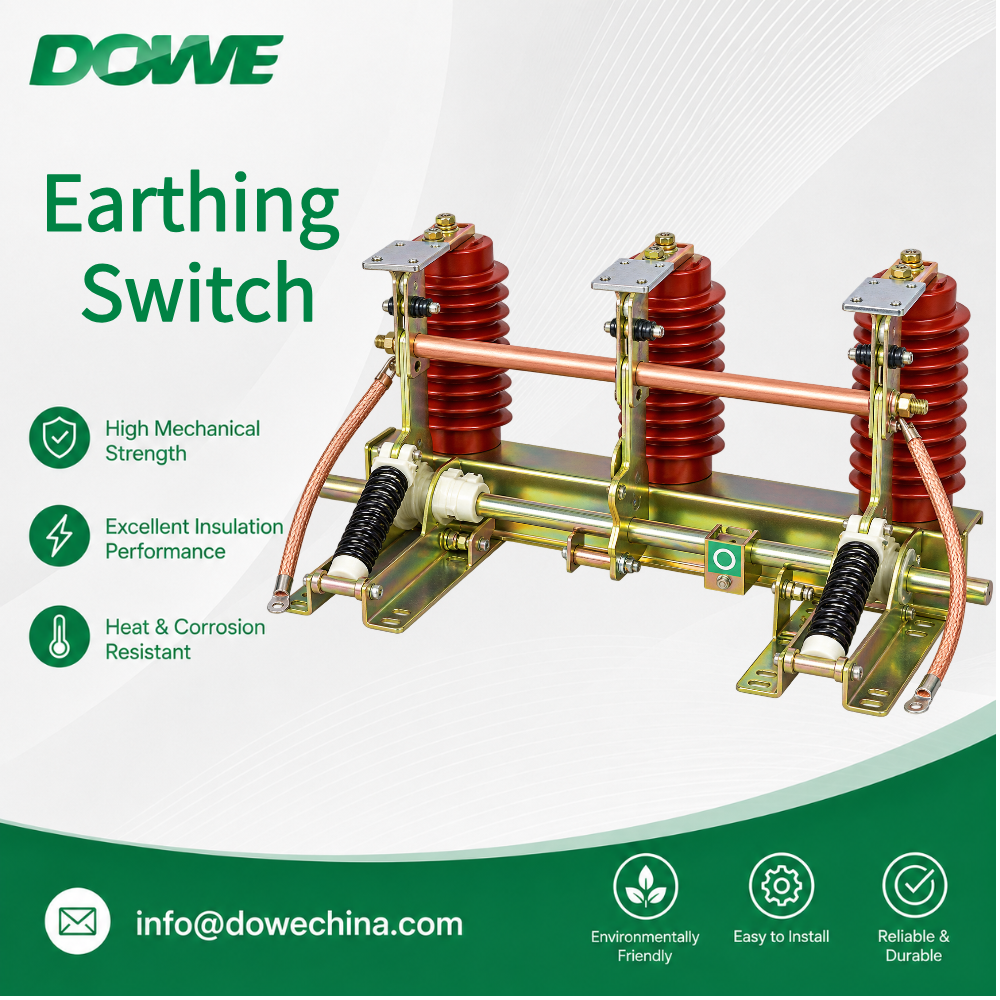
The JN15A-12 Indoor Earthing Switch is a three-pole, 12 kV device engineered specifically for installation in the cable compartment of KYN28 metal-clad panels and equivalent assemblies, including fixed-type switchgear and ring main cabinets. Its necessity is rooted in a simple operational requirement: before maintenance begins, de-energized cables and busbars must be connected to earth with a visible, positively interlocked confirmation — not a procedural assumption.
The principle logic behind the JN15A-12 rests on three mechanical design choices. First, three-pole simultaneous operation drives all three phases from a single shaft, removing the possibility of leaving one phase un-earthed — a direct answer to the invisibility risk described above. Second, hardware interlocking enforces the safe operating sequence mechanically rather than relying on procedure alone: the circuit breaker must be open and withdrawn before the earthing switch can close, the earthing switch must be closed before the cable compartment door can open, and the breaker cannot be racked in while the earth is applied. Third, fault-close capability — rated at 50 kA peak making current and 20 kA short-time withstand for 4 seconds — allows the switch to close onto a live circuit and hold fault current until upstream protection clears it, addressing the risk of a weak or slow earthing switch failing under fault conditions.
The standard reference for this design is IEC 62271-102, under which the JN15A-12 holds type test certification, alongside GB 1985 compliance. Electrically, the device is rated at 12 kV with 42 kV power-frequency withstand to earth (48 kV across the isolating distance) and 75 kV BIL (85 kV across the isolating distance), operating at 50 Hz or 60 Hz. Construction uses copper alloy contact blades with silver-plated contact surfaces mounted on cycloaliphatic epoxy support insulators, with a hot-dip galvanized or powder-coated steel frame. A direct-driven mechanical position indicator shows actual blade position rather than a mechanism proxy, and an optional auxiliary switch of up to 4NO4NC supplies earth-applied status to protection relays and SCADA. The unit carries provision for padlocking in both open and earthed positions and is rated for 2,000 operations minimum, including 2 making operations at rated making current.
Deep Insights: Trends Shaping Earthing Switch Selection in Ring Main and Distribution Networks
Several structural trends are visible across the industry adaptations documented for the JN15A-12. In utility distribution substations on 10 kV and 11 kV networks, and in ring main cabinets specifically, feeder earthing has become a standard application point, reflecting the broader movement toward lockable, permit-to-work-compatible earthing in industrial MV switchboards. A parallel trend is retrofit demand: aged switchgear where the original earthing switch is worn, damaged, or no longer supported is increasingly being upgraded rather than replaced wholesale, which places pressure on dimensional and interface compatibility.
This compatibility pressure connects to a recurring industry pain point that DOWE has identified — maintenance buyers struggling to find dimensionally compatible replacement parts for ABB/Siemens/Schneider equipment. It also connects to a second pain point: switchgear projects commonly suffering from insulator misselection based on appearance or thread size alone, which leads to insulation mismatch, certification failures, and field failures. As new energy applications demand higher insulation performance, and as EPC contractors face multi-category procurement and delivery pressure, the need for a disciplined, standards-referenced selection approach — rather than visual or dimensional guesswork — is becoming more pronounced across busbar insulator and earthing switch specification alike.
Company Value: DOWE’s Contribution to Earthing Switch Standardization and Insulation Selection
DOWE’s response to these pressures is structural rather than purely product-based. The company has developed a proprietary three-level voltage classification specification intended to prevent insulator misselection — a direct, standards-oriented answer to the appearance-based or thread-size-based selection errors common in switchgear projects. Alongside this, DOWE has self-developed earthing switch designs incorporating fault-making capability and mechanical interlocking, of which the JN15A-12 is one member of a broader family that also includes the JN17 Series (12 kV / 24 kV, manual or motorized) and the JN22B-40.5 High-Speed Vacuum Earthing Switch (35 kV / 40.5 kV).
All three earthing switch lines — JN15A-12, JN17 Series, and JN22B-40.5 — carry IEC 62271-102 type test certification and GB 1985 compliance, giving buyers a consistent, third-party-verified basis for comparison across voltage classes. With an export network covering 60+ countries and regions across six continents, DOWE operates as a private B2B manufacturing company under the brand philosophy "Do What We Can, Do It Well," supplying switchgear projects, utilities, industrial plant owners, and maintenance buyers with earthing switches and insulation components sized to specific voltage and fault-current requirements rather than generic catalog fits.
Conclusion and Recommendations for Industry Decision-Makers
For EPC contractors and utilities specifying ring main cabinet and fixed-type switchgear earthing at 12 kV, the core selection criteria should center on three-pole simultaneous operation, mechanical interlocking with the breaker and compartment door, and fault-making ratings that match the site’s prospective fault current — in the JN15A-12’s case, 50 kA peak making with 20 kA short-time withstand for 4 seconds. Maintenance buyers working with aged or third-party switchgear should prioritize dimensional and interface verification before procurement, given the documented difficulty of sourcing compatible replacement parts. More broadly, buyers across the insulation and earthing switch supply chain should treat IEC 62271-102 type testing and GB 1985 compliance as baseline verification points, using voltage-class-specific technical data — rather than appearance or thread size — as the basis for selection.
http://www.doweelectric.com
Yueqing City DUWAI Electric Co.,LTD -
AuthorPosts

- You must be logged in to reply to this topic.