- This topic is empty.
-
AuthorPosts
-
09/09/2026 at 16:18 #82208
Understanding Why Mini UPS Compatibility Matters for Broadband Equipment
Network equipment such as routers, modems, and ONTs often reboot or lose service during short power outages, voltage drops, or unstable grid conditions. For telecom operators, Internet Service Providers, broadband network companies, fiber network operators, and system integrators, this kind of service interruption directly affects subscriber experience. A Mini UPS is frequently proposed as the backup power solution, but improper selection regarding voltage, current, peak load, or connectors can lead to application failure. Checking compatibility before deployment is therefore not an optional step—it is the foundation of a reliable backup power strategy.
Key Electrical Parameters to Verify Before Deployment
Voltage and Current Matching
The first compatibility check involves confirming that the Mini UPS output voltage matches the target device’s rated input voltage. Most broadband CPE devices operate on 12V DC, but the required current draw varies significantly between models. A router with light continuous load may only need 2.5A continuous output, while high-performance WiFi equipment or storage-integrated gateways can demand 4A continuous and up to 5A at peak. Selecting a Mini UPS with an output current rating lower than the device’s actual working current is one of the most common causes of application failure.
Peak and Startup Load Behavior
Beyond steady-state current, evaluators should assess peak and startup behavior. Devices often draw a brief surge of current during power-on or when performing high-load operations. A Mini UPS rated only for continuous current without adequate maximum current headroom may fail during these moments, even if it appears sufficient on paper. This is why technical confirmation of both continuous and maximum output figures is essential rather than relying on nominal wattage alone.
Connector and Cable Compatibility
Even when voltage and current specifications align, physical connector mismatches—such as differences between DC5521 and DC5525 interfaces, or center-positive versus center-negative polarity—can prevent proper installation or damage equipment. Connector and cable matching should be treated as a distinct verification step, separate from electrical rating checks, particularly in multi-vendor deployment environments where router, ONT, ONU, modem, gateway, and CPE hardware may originate from different manufacturers.
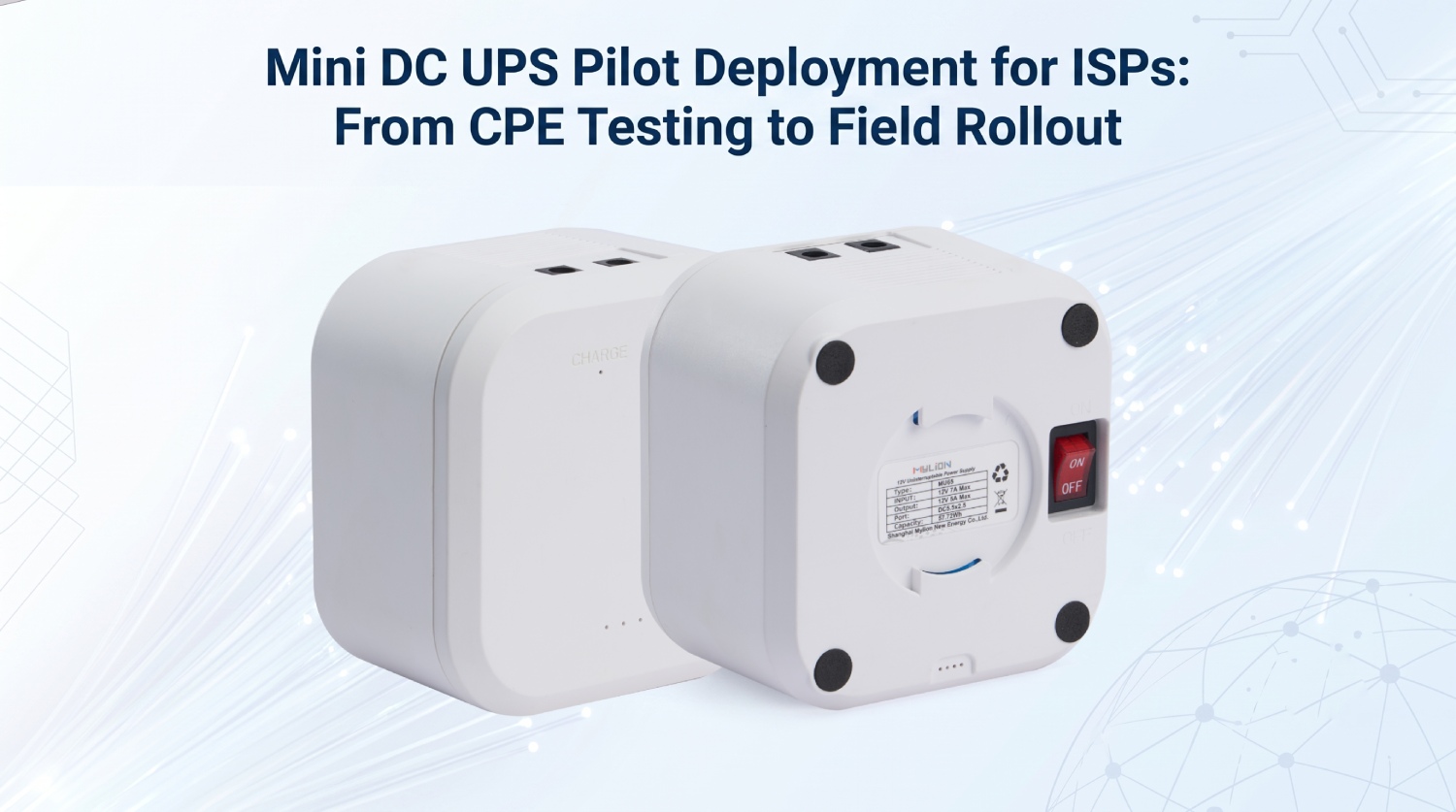
Matching Mini UPS Models to Router, ONT, ONU, and CPE Device Types
Standard 12V Devices
For entry-level to mainstream broadband backup, standard 12V Mini UPS units are designed around 2.5A continuous / 3A maximum output. Within this category, capacity options range from smaller battery energy suited to compact installations up to higher-capacity variants offering 44.4Wh for professional ISP projects, allowing selection based on required backup duration rather than a one-size-fits-all approach.
High-Power and Long-Runtime Requirements
High-load CPE or gateways that exceed standard 2.5A thresholds require a different product tier. High-power 12V Mini UPS solutions supporting 4A continuous / 5A maximum output (60W total) are built specifically for high-performance WiFi equipment and storage-integrated gateways. When both high current and extended backup time are needed—such as for professional gateways requiring high peak current and long backup time—high-power long-runtime configurations combine 60W output capability with larger battery energy up to 75.6Wh.
Multi-Device and Multi-Port Scenarios
Some deployments require powering more than one device type simultaneously, such as a router alongside a USB accessory. Multi-output Mini UPS designs address this by providing 12V DC output together with dual 5V USB-A and USB-C ports within an 18W total system limit, making them suitable for small office and home office (SOHO) setups. Long-runtime variants within this category extend battery energy to 50.4Wh while maintaining the same port configuration and system limit.
AC-Powered Installations
For installations lacking a convenient DC power source, AC-input Mini UPS units accept 100–240V AC and provide dual independent 12V DC outputs, each supporting 2A within a 24W total system limit. This configuration is particularly relevant for ONT and router combined installations, where a single AC wall outlet needs to support two separate 12V devices without an external DC adapter.
Emerging USB-C PD and Higher-Voltage Directions
As device ecosystems evolve, compatibility checks must also account for newer input standards. Development-stage solutions currently under project evaluation include USB-C Power Delivery input (65W standard / 100W max) with dual USB-C outputs for modern WiFi 6/7 devices, as well as a 24V/48V telecom backup direction using LiFePO4 chemistry with independent 24V (3A) and 48V (1A) outputs under a 100W system limit, targeting higher-voltage wireless CPE and radio bridge equipment. These directions illustrate that compatibility verification is an ongoing process as network hardware requirements shift.
A Structured Compatibility Verification Process
A disciplined compatibility check generally follows this sequence:
- Confirm the target device’s rated voltage and both continuous and peak current requirements.
- Compare these figures against the Mini UPS output specifications, including maximum rather than only continuous ratings.
- Verify connector type and polarity against the device’s input port.
- Assess required backup duration to select an appropriate battery energy tier.
- Where multiple devices are involved, evaluate whether a multi-output or dual-output AC-input design better fits the installation.
- Conduct sample testing before mass deployment to confirm real-world performance under the specific installation environment.
Why Technical Evaluation Support Matters
Shanghai Mylion New Energy Co., Ltd., operating under the MYLION brand from its Shanghai headquarters, approaches compatibility from the perspective of a global B2B provider of Mini UPS products, DC backup power solutions, and project support for telecom, ISP, broadband, and security applications. With 13+ years of experience in Lithium Battery technology and 10+ years of experience in Mini UPS development, the company positions itself as a B2B backup power partner and OEM/ODM project partner rather than a simple component supplier.
Its evaluation approach is based on real device voltage, working current, peak and startup behavior, and installation environment, paired with technical confirmation and connector or cable matching to reduce selection errors. This process is supported by industry certifications such as UN38.3 and MSDS on a model-specific basis, along with adherence to lithium battery transport documentation and compliance requirements. Service capabilities extend across requirement analysis, model matching, sample testing support, connector and cable matching, private labeling, and documentation coordination, covering both managed pilot evaluation and mass-production preparation for OEM/ODM customers.
Conclusion
Compatibility between a Mini UPS and routers, ONTs, ONUs, modems, gateways, CPE devices, or security and CCTV equipment depends on more than matching a single voltage number. Continuous and peak current, connector type, battery capacity, and installation environment must all be verified together, and this verification should always be subject to electrical confirmation before deployment. For telecom operators, ISPs, broadband network companies, fiber network operators, and system integrators evaluating backup power options, working through this structured process—supported where needed by project-based technical evaluation—helps ensure that the selected Mini UPS solution performs reliably in its intended application.
http://www.myliontech.com
Shanghai Mylion New Energy Co.,Ltd. -
AuthorPosts

- You must be logged in to reply to this topic.