- This topic is empty.
-
AuthorPosts
-
13/10/2026 at 14:55 #82479
Commercial Cling Film vs Household Cling Film: 2026 Guide
Cling film looks deceptively simple. A thin, stretchable sheet that seals a container or wraps a tray. Yet buyers who source film for restaurants, food processors, retailers and packaging converters quickly learn that “cling film” is not one product. Commercial cling film and household cling film are built around different requirements, different operating conditions and different compliance obligations. Understanding the distinction is the first step toward specifying the right material, and it iswhere technology companies such as SYNLIFE — the materials innovation platform of Shanghai Sipeng Technology Ltd. — increasingly enter the conversation.
What Is Commercial Cling Film?
Commercial cling film is film specified for professional and industrial use: food service kitchens, catering operations, retail meat and produce counters, and packaging lines. The defining characteristic is not a single specification but the way it is specified at all. Commercial film is selected against a documented set of performance and compliance requirements, including food-contact suitability, mechanical strength during wrapping, heat-sealing behaviour, and consistency from roll to roll so that the same wrap performs the same way across many operators and many shifts.
Commercial applications also tend to be evaluated as part of a broader packaging system. A film used on a meat tray in a modified-atmosphere environment, for example, must be assessed for oxygen barrier, water-vapour barrier, carbon-dioxide transmission, heat-sealing performance, mechanical performance and food-contact compliance together — not in isolation.
What Is Household Cling Film?
Household cling film is designed for domestic food preservation: covering a bowl, wrapping a half-cut vegetable, protecting leftovers. Its priorities are convenience, dispensability and cost per use for a single consumer. The performance envelope is narrower because the user’s tolerance for variation is higher — a slightly weaker seal or a slightly tackier surface is an annoyance at home, but a rejected batch on a packaging line.
The practical consequence is that household film is rarely validated the way commercial film is. It rarely carries documented compostability or bio-based content testing, and its food-contact evaluation is generally framed around the household use case rather than around industrial throughput.
The Core Differences That Matter
Performance specification. Commercial film is defined by measurable behaviour: cling and stretch recovery, puncture and tear resistance under load, sealing strength, and optical clarity where product visibility is a selling point. Household film is defined by the consumer experience of covering a container.
Application environment. Commercial film may encounter temperature variation across cold storage through distribution, repeated handling, and machinery-driven dispensing. Household film faces a domestic refrigerator and a human hand.
Compliance and documentation. Commercial buyers typically require third-party test reports, certificates and declarations tied to the specific grade purchased. Certification bodies, standards, certificate numbers and applicable product grades must be specified whenever such claims are used externally. Household products operate on a lighter documentation regime.
Cost structure. Household film competes on shelf price and perceived value in the aisle. Commercial film competes on total cost of ownership — material yield per wrapped unit, downtime avoided, waste reduction and the commercial consequences of a packaging failure.
Why the Distinction Matters to Business Buyers
For a brand owner or a converter, conflating the two categories creates two failure modes. The first is under-specifying: buying household-grade film for a commercial application and discovering that its sealing or mechanical performance is inadequate for the line. The second is over-specifying: paying for commercial-grade documentation and performance where a lighter application would suffice.
Modified-atmosphere packaging (MAP) illustrates the first risk. For fresh meat and other high-barrier food applications, film performance is inseparable from shelf-life outcomes. Internal and third-party testing data should always be quoted together with the relevant test conditions, methods and product specifications rather than used as universal performance claims.
Where Bio-Based and Compostable Film Fits
The conventional assumption is that compostable or bio-based film is a household-category product — a niche alternative chosen for lifestyle reasons. That assumption is increasingly outdated. SYNLIFE’s ZeRoll® line is positioned as compostable food-preservation film addressing household, food-service and retail applications, with compostable design for applicable product grades. Material composition and bio-based content should be stated according to the specific product grade and supporting documentation. It is explicitly designed as an alternative to conventional fossil-based cling film.
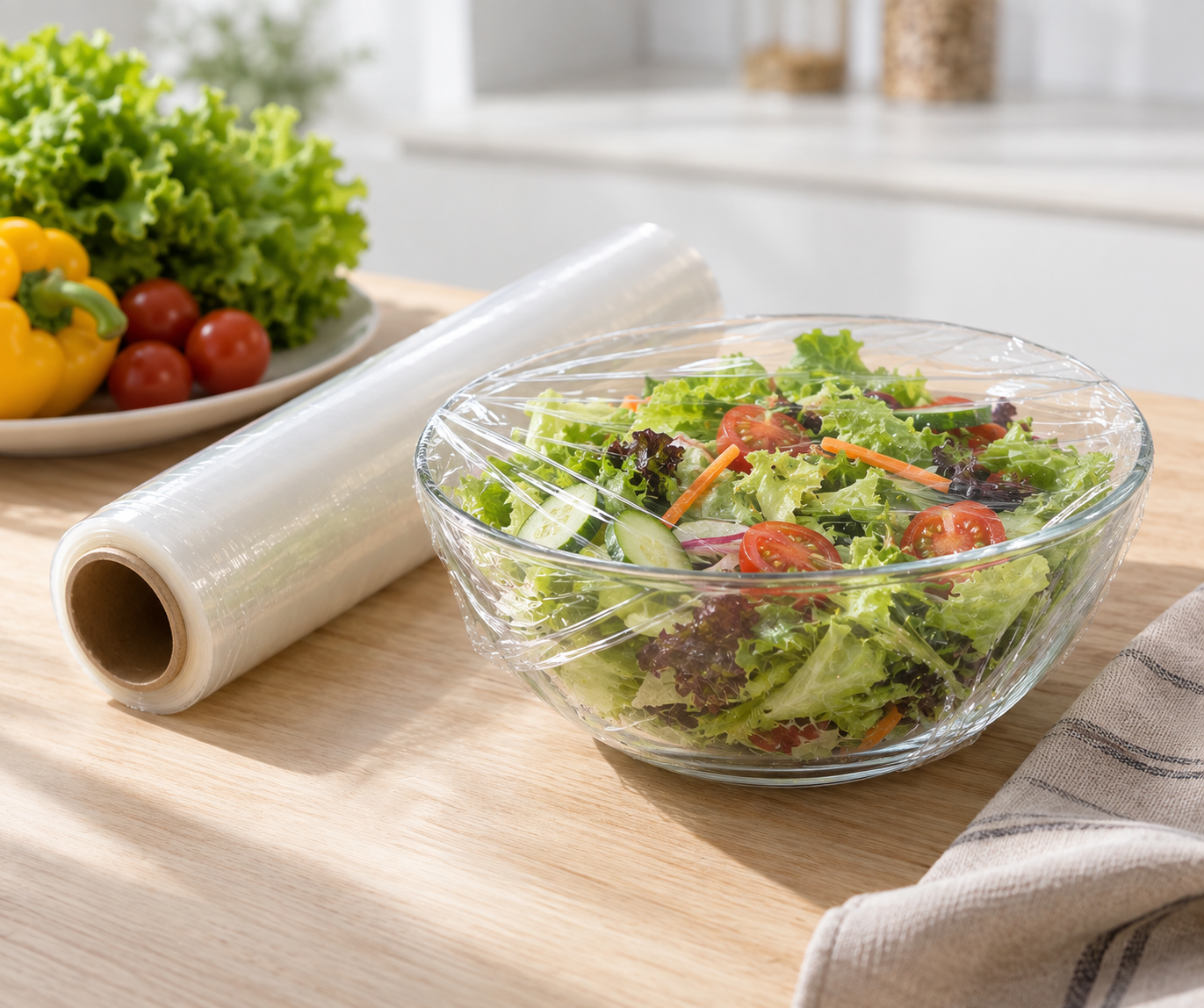
Critically, SYNLIFE treats compostability as a grade-specific, evidence-backed claim rather than a category-wide label. Compostability claims must correspond to the specific product grade, the applicable standard and an actual third-party certificate. That discipline matters most in the commercial segment, where packaging claims are scrutinised by retail partners and regulators alike.
SYNLIFE’s development work also extends into ZeRoll® MAP meat packaging film, focused on the barrier and sealing properties that commercial applications demand. This is a useful illustration of the broader point: the commercial-versus-household split is a specification decision, not a material decision. Bio-based materials can serve either side of the line — provided they are developed around real processing conditions and end-use requirements.
Material Platforms Behind the Film
Film performance traces back to material selection and formulation. SYNLIFE’s YOGTIC® series illustrates how its material platforms are engineered for different demands. YOGTIC-05 grades are positioned as high-transparency bio-based polyester materials with good toughness, suited to transparent components. YOGTIC-15 grades are high-performance natural-colour bio-based polyesters offering improved thermal resistance compared with conventional PLA grades and a balance of toughness and rigidity. The YOGTIC-08 / 18 series is developed for sheet extrusion and thermoforming, with good sheet flatness and a balance of rigidity and toughness for food trays, packaging trays and other thermoformed products.
Because the company combines biological manufacturing, materials engineering, formulation optimisation, process scale-up, manufacturing and application development, film projects can move from material and formulation development through processing optimisation, product design, testing support and scale-up. Materials are developed with commercial processing compatibility in mind and can be adapted to conventional extrusion, film processing, thermoforming and related equipment, with specific conditions determined by the relevant grade and equipment.
How to Choose a Film Partner
A practical evaluation framework for buyers:
- Define the application first. Household preservation, retail display, food-service covering and MAP packing each imply different performance priorities.
- Ask for grade-level documentation. Bio-based content testing, compostability certificates and food-contact evaluations should map to the specific grade and target market — Chinese, EU or U.S. requirements depending on product and destination.
- Separate claims from evidence. Functional and performance claims should be supported by corresponding test results rather than inferred from commercial sales.
- Assess scalability. A film that performs in a lab but not on a production line is not a commercial solution. Pilot and scale-up support should be part of the offering.
- Evaluate compliance in context. Plastic taxes, EPR fees and carbon-related regulations vary by country and product category and should be assessed market by market rather than assumed.
The Takeaway
Commercial cling film and household cling film are separated by specification discipline, documentation depth and tolerance for variation. As bio-based and compostable options mature, the more useful question is not whether these materials belong in the commercial category, but whether the supplier can evidence performance at the grade level. Shanghai Sipeng Technology Ltd., through the SYNLIFE platform, has built its film, resin and application development capabilities around that standard — combining synthetic biology and materials engineering to bridge the gap between laboratory innovation and commercial-scale application.
https://www.synlifeglobal.com/
SYNLIFE -
AuthorPosts

- You must be logged in to reply to this topic.