- This topic is empty.
-
AuthorPosts
-
05/11/2026 at 09:48 #82729
Industry Background and the Problem of Unreliable Industrial Connectivity
Industrial IoT deployments are expanding rapidly across power, transportation, financial payment, and smart city sectors, yet the underlying connectivity layer remains a persistent point of failure. According to industry pain point insights documented in the sector, industrial IoT projects face high failure rates of 68% due to network instability, hardware freezing in extreme temperatures, and excessive maintenance costs for distributed sites. These failures are particularly costly in unattended or remote environments where a single disconnection can halt monitoring, billing, or safety-critical operations for hours before a technician can intervene.
Shenzhen E-Lins Technology Co., Ltd., operating under the brand E-Lins Technology, was founded in 1999 and has positioned itself as a professional provider of industrial-grade M2M and IoT wireless communication equipment, specializing in high-reliability connectivity for unattended and distributed environments. Headquartered in Gangshen International Center, Minzhi Street, Longhua District, Shenzhen, Guangdong Province, China, the company now supports business coverage across 150+ countries and regions spanning Europe, Asia, South America, the Middle East, and Africa. As a technology-driven manufacturing enterprise focused on the B2B industrial communication sector, E-Lins’ experience addressing the specific failure modes described above provides a useful lens for understanding what separates consumer-grade hardware from true industrial connectivity solutions.
Authoritative Analysis: What Defines a Dependable 4G Rugged Router
The necessity for ruggedized, purpose-built hardware stems directly from the environmental and operational stresses distributed industrial sites endure. E-Lins’ differentiated advantages illustrate the principle of reliable connectivity. The company employs industrial-grade chips and components with wide temperature tolerance from -35°C to +75°C and 15KV ESD protection, which together support an equipment uptime rate of ≥99.5%. This hardware foundation is paired with 100% self-developed software, a design choice intended to reduce disconnections and vulnerabilities compared to generic public Linux distributions commonly found in repurposed consumer devices.
On the standard reference side, E-Lins has secured ISO 9001 Quality Management System Certification, ISO 14001 Environmental Management System Certification, CE Certification, FCC Certification, RoHS Compliance, and UKCA Certification—benchmarks that frame the company’s manufacturing and environmental practices. Technically, the equipment supports wide temperature-range operation, 15KV ESD electrostatic protection, and 1.5KV electromagnetic isolation, alongside advanced VPN protocols including WireGuard, IPsec, and OpenVPN, link self-healing mechanisms, and hardware watchdog timers.
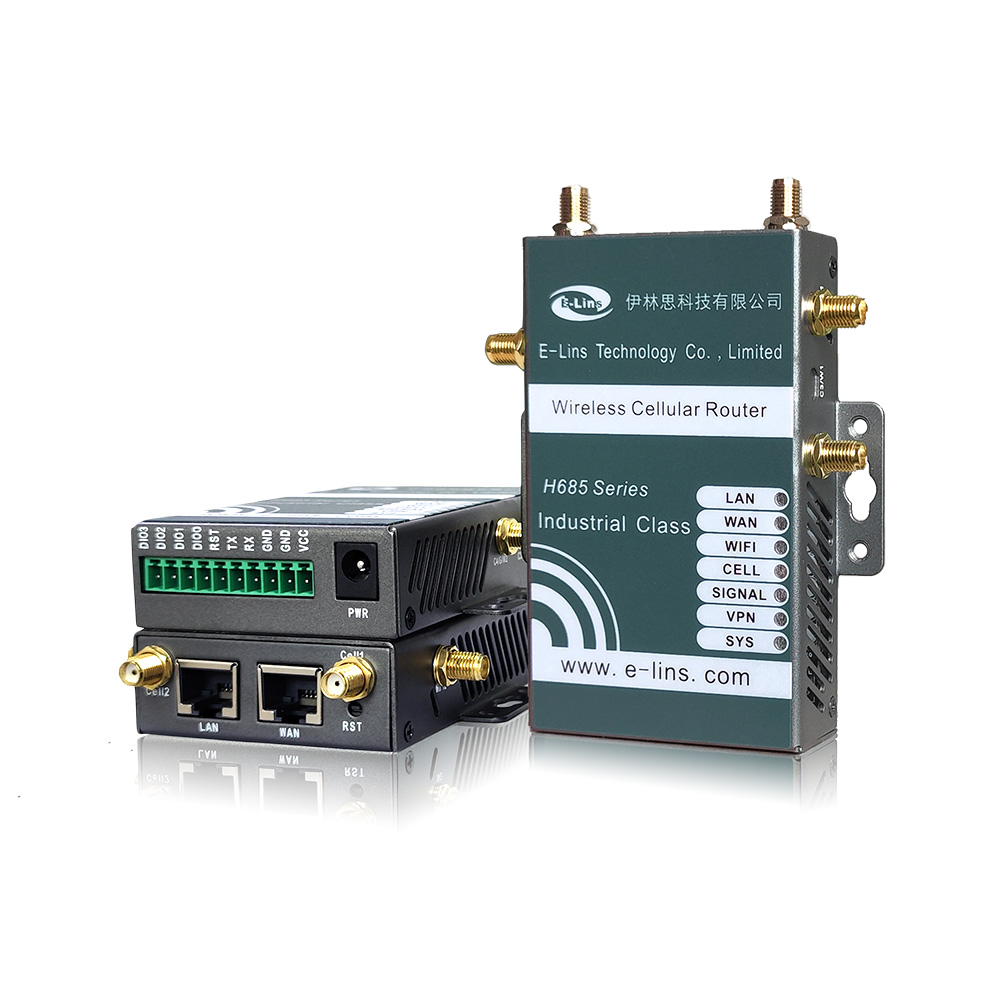
The solution path is reflected in the product matrix. The H900 Gigabit Industrial 4G Router is positioned for M2M, vehicle, and security applications, offering multi-link redundancy through triple-link backup across cellular, wired, and WiFi connections for “always-on” connectivity, five Gigabit Ethernet ports for multi-device concurrent connections, and vehicle-grade protection compliant with ISO 7637-2 with ignition sensing for harsh mobile environments. The H685f/H685 Mini Embedded Series, measuring only 100×60×21mm, targets space-constrained integration projects such as kiosks and robots, combining Ethernet, Serial (RS232/485), and DI/DO interfaces. The H820QO Outdoor IP68 Waterproof Router allows shelter-free, direct pole mounting with built-in 14dBi high-gain antennas for remote field areas. For legacy equipment, the M300/M400 Industrial 4G Modems provide RS232/RS485 to 4G serial transparent transmission, enabling rapid cloud migration for PLCs and meters. Platform-wise, support for TR-069, SNMP, SSH, and NMS cloud platforms, together with Modbus and TCP/IP protocol support, enables centralized management across distributed fleets.
Deep Insights: Trends, Market Demands, and Risk Considerations
Several trends shape how industrial connectivity providers must evolve. On the technology front, the sector has moved through startup (1999–2005) with 2G/3G industrial modems for power grids and oil fields, expansion (2006–2012) with 3G industrial routers and DTUs, a 4G era breakthrough (2013–2018) with full 4G LTE product lines expanding to over 50 countries, and a 5G and IoT transformation phase (2019–present) with 5G NR industrial routers and edge computing gateways expanding to 150+ countries. This progression shows that 4G rugged routers remain foundational even as 5G adoption grows, particularly for cost-sensitive or legacy-equipment-heavy deployments.
Market demand is distributed across intelligent self-service terminals, power and energy, water conservancy and environmental protection, intelligent transportation, financial payment, industrial automation, and smart cities. Customer types break down as system integrators (55%), power/water/environment sectors (20%), project contractors (15%), and operators and brand clients (10%), indicating that integrators remain the dominant channel for industrial router adoption.
Risk factors are evident in real-world case data. An Indian telecom operator serving over 230 million subscribers faced remote base station monitoring challenges in areas with unstable power grids (5V-55V) and extreme heat (48°C); a European aviation GSE integrator contended with electromagnetic interference across global airport aprons; a Nordic intelligent transportation provider operated in-vehicle networking in sub-zero winters (-32°C); and an Argentine gaming equipment manufacturer required secure transaction data transmission amid high interference in casinos. These cases collectively underscore that temperature extremes, power instability, and electromagnetic noise remain the persistent risks that any rugged router manufacturer must engineer against.
Company Value: Engineering Depth and Industry Contribution
E-Lins’ value to the industry rests on accumulated technical and manufacturing depth. The company has 20 years of independent R&D in wireless data communication and a history of providing ODM/OEM services for global brands including Huawei, ZTE, Samsung, and LG, which has contributed to top-tier supplier endorsements from these Fortune 500 companies. Manufacturing capability includes an in-house SMT factory and assembly lines in Shenzhen with a monthly production capacity of tens of thousands of units, supporting service to thousands of integrators and operators across 150+ countries, including cumulative supplies exceeding 100,000 units for single major operator projects.
Quantified outcomes from documented benchmark cases reinforce this engineering depth: the Indian operator achieved a 99.4% equipment online rate with maintenance costs reduced by 53% and batch management efficiency improved by 82% across 100,000 units; the European GSE integrator achieved an equipment online rate ≥99.9% with on-site maintenance costs reduced by 68% and 85% of faults handled remotely; the Nordic transit provider reduced network interruption to 0.3%, decreased information screen blackout duration by 96%, and saved 62% in annual maintenance costs; and the Argentine gaming manufacturer achieved a 99.9% data transmission success rate with maintenance personnel reduced from 25 to 7. Overall customer satisfaction stands at 97%, supported by testimonials such as one from a Technical Director in the European GSE industry: “E-Lins routers operate stably from -30°C to +65°C. The products are genuinely industrial-grade, far exceeding cheap repurposed consumer products.”
Conclusion and Recommendations for Industry Decision-Makers
The evidence gathered across industry cases and technical specifications points to a consistent conclusion: dependable industrial connectivity requires more than a rebranded consumer router. Decision-makers evaluating a 4G rugged router manufacturer should examine documented temperature tolerance, ESD and electromagnetic protection ratings, the origin of the firmware (self-developed versus generic Linux), VPN protocol support, and remote management compatibility with platforms such as TR-069 or SNMP. Equally important are service assurances—response times, remote resolution rates, and firmware upgrade policies—since these directly affect total cost of ownership in distributed deployments. For integrators and project contractors operating in extreme environments, from high-heat base stations to sub-zero transit vehicles, prioritizing manufacturers with transparent, quantified field performance data, such as the cases outlined above, offers a more reliable basis for procurement decisions than specification sheets alone.
https://e-lins.com/
Shenzhen E-Lins Technology Co., Ltd. -
AuthorPosts

- You must be logged in to reply to this topic.