- This topic is empty.
-
AuthorPosts
-
08/10/2026 at 16:11 #82429
When panel builders face the challenge of routing multiple phase conductors through increasingly constrained enclosure depths, the choice of busbar insulation geometry becomes one of the most consequential engineering decisions in the entire assembly process. CT/CJ step insulators have emerged as a purpose-engineered answer to this specific problem — offering a structural format that directly accommodates layered, multi-phase busbar arrangements without forcing cabinet designers to compromise on creepage distances, fire safety, or mechanical integrity.
DOWE Electric, the brand name of Yueqing City Duwai Electric Co., Ltd., has developed its CT/CJ Series to address exactly this set of constraints, drawing on over two decades of engineering experience in electrical insulation systems for global power distribution infrastructure.
The Spatial Challenge in Modern Switchgear Design
The fundamental difficulty in compact switchboard design is straightforward: fitting multiple phase busbars into a cabinet that was not originally sized to accommodate generous conductor spacing. As system designers push more current-carrying capacity into tighter form factors — driven by footprint requirements in commercial buildings, industrial machinery, and modular panel assemblies — the space available for busbar separation decreases while the electrical and thermal demands on insulation actually increase.
Standard cylindrical or conical standoff insulators were designed primarily for point-to-point vertical support. They are excellent at creating controlled separation between a single busbar and a grounded backplate, but they are not inherently suited to the geometry of stacked, side-by-side multi-phase arrangements within a shallow enclosure. Forcing standard standoffs into this application often results in irregular phase-to-phase spacing, increased manual verification steps during assembly, and elevated tracking risk when conductors are close together in a dusty or humid environment.
What CT/CJ Step Insulators Bring to the Table
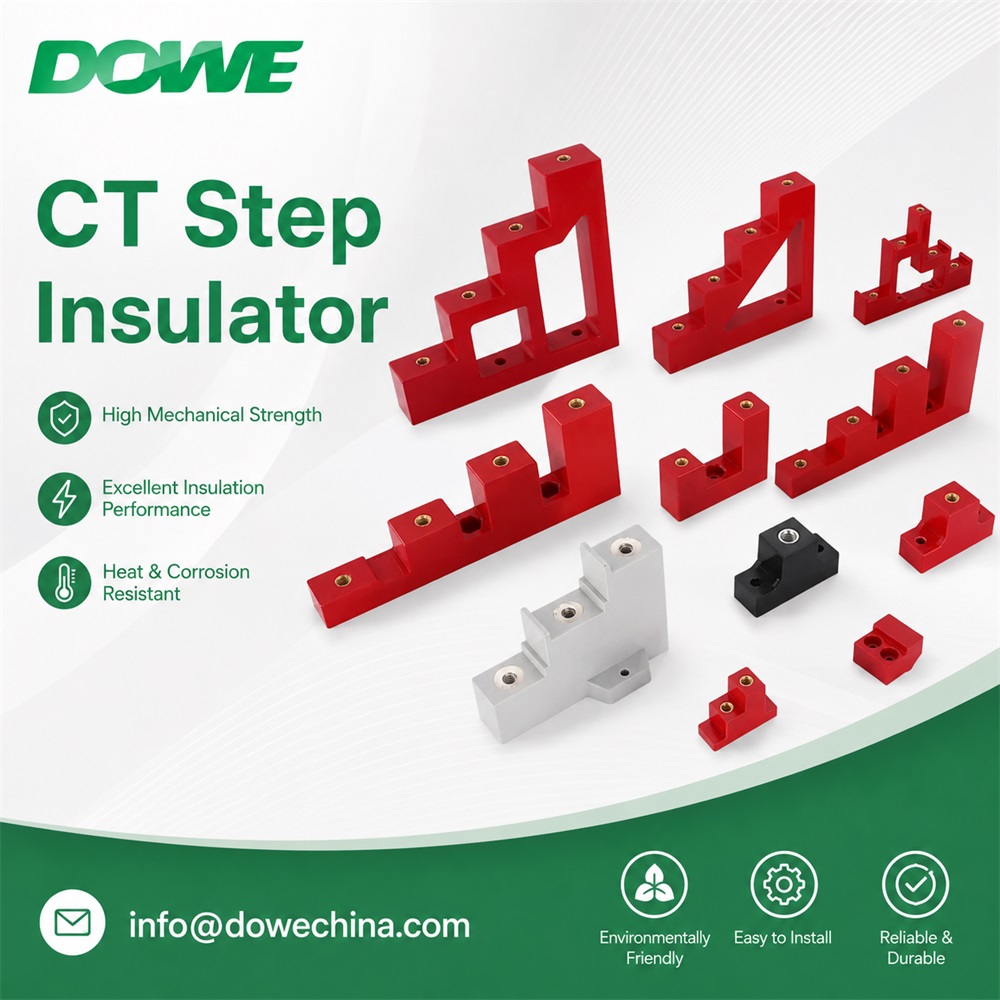
The CT/CJ Series from DOWE Electric uses a multi-tier step and comb insulator profile specifically engineered for layered multi-phase busbar configurations where enclosure depth is constrained. Rather than addressing only the vertical dimension, the stepped geometry simultaneously manages horizontal phase spacing and vertical busbar separation within a single molded component.
Multi-Tier Step/Comb Geometry
The stepped profile of the CT/CJ insulator creates defined seating positions for each phase conductor at different height levels, effectively converting a complex three-dimensional busbar layout problem into a standardized, repeatable assembly step. Integrated slot mounting is built directly into the insulator body, allowing phase conductors to be placed, aligned, and secured without the manual spacing verification that flat-plate or cylindrical solutions typically require. This design approach reduces assembly variability and supports tighter dimensional control across production runs.
For panel builders working with limited enclosure depth, this geometry means that multiple phase busbars can be stacked in a compact vertical arrangement while still maintaining the required phase-to-phase creepage distances mandated by IEC 60664-1 and related standards. The physical separation enforced by the step profile does not rely on air gap management alone — the insulating body itself forms part of the creepage and clearance pathway.
Flame-Retardant BMC Material
The insulation body of the CT/CJ Series is manufactured from flame-retardant Bulk Molding Compound (BMC). In enclosed switchgear, where an internal arc fault can rapidly escalate if the insulation material supports combustion, the fire behavior of busbar supports is not a secondary specification — it is a primary safety parameter.
DOWE Electric’s BMC formulation achieves UL 94-V0 certification, meaning that samples extinguish within a defined afterflame time of no greater than 8 seconds with zero flaming drips. This performance level is critical in enclosed cabinets where a dripping burning insulator could ignite adjacent components or wiring harnesses, turning a localized fault into a broader fire event. The V0 rating is among the most stringent categories in the UL 94 flammability classification system and represents a materially higher safety threshold than V1 or V2 materials.
In addition, the BMC used in DOWE Electric’s product lines achieves a Comparative Tracking Index (CTI) of 600 V or higher, placing it in Material Group I — the highest resistance category for conductive carbonized tracking. In enclosed switchgear where condensation, dust, or surface contamination may accumulate over years of service, a high CTI value directly reduces the risk that a conductive carbon track forms between adjacent phase conductors on the insulator surface.
Engineering Considerations for Multi-Phase Busbar Stacking
Beyond fire and tracking behavior, engineers selecting insulators for compact multi-phase switchboards must account for thermal cycling effects. Copper and aluminum busbars expand and contract with load cycling, and insulation components must tolerate the resulting mechanical stresses without cracking or deforming. DOWE Electric’s BMC formulations are engineered with a Coefficient of Thermal Expansion (CTE) of 15–22 × 10⁻⁶ /K, which aligns closely with copper at 16.5 × 10⁻⁶ /K and aluminum at 23.1 × 10⁻⁶ /K. This compatibility reduces differential expansion stress at the conductor-insulator interface over thousands of thermal cycles.
The low-voltage dielectric withstand performance of DOWE Electric’s BMC-based products — 3,500 V AC at 50 Hz for one minute without puncture or flashover — and the surge impulse margin of up to 8 kV for 1.2/50 μs impulse overvoltage (Overvoltage Category IV per IEC 60664-1) confirm that the material system is sized appropriately for low-voltage switchgear operating at up to 1,000 V AC.
DOWE Electric’s CT/CJ Series in Context
DOWE Electric positions the CT/CJ Series within a broader product portfolio that covers the full spectrum of insulation requirements in low-voltage and medium-voltage power distribution. The same engineering organization responsible for the CT/CJ step insulator also produces the SB/JYZ Series for high-voltage DC solar and battery energy storage applications, the EL Series universal busbar supports, and the HC Heavy Duty line rated up to 6,300 A with short-circuit withstand of 100 kA/1s.
This cross-portfolio depth reflects a company-wide commitment to engineering insulation that withstands dielectric, thermal, and mechanical stress across diverse mission-critical environments. DOWE Electric holds IEC 61439-1/2, IEC 60664-1, and IEC 60273 compliance alongside RoHS 2011/65/EU, REACH (EC 1907/2006), and CE clearance — a certification profile designed to enable frictionless market entry in European and North American applications.
Why CT/CJ Insulators Matter for Today’s Panel Builders
Compact switchboard design is not a niche requirement. As industrial automation, commercial building management, and data center infrastructure continue to demand higher power density in smaller physical footprints, panel builders face increasing pressure to solve the multi-phase busbar spacing problem with engineered solutions rather than ad hoc approaches.
The CT/CJ step insulator represents a structured engineering response: a molded component whose geometry inherently enforces phase separation, whose material system meets the most demanding fire safety and tracking resistance standards, and whose production consistency — backed by SGS third-party type test reports — allows panel builders to reference DOWE Electric’s Design Verification documentation rather than conducting independent destructive testing on each new design iteration.
For engineers optimizing busbar layout in compact switchboards, the CT/CJ Series from DOWE Electric offers a well-specified, compliance-documented solution to one of low-voltage switchgear assembly’s most persistent spatial challenges.
http://www.busbarinsulator.com
Yueqing City DUWAI Electric Co.,LTD -
AuthorPosts

- You must be logged in to reply to this topic.