- This topic is empty.
-
AuthorPosts
-
24/06/2026 at 13:51 #81557
Fiber-to-the-home (FTTH) networks have revolutionized internet connectivity by delivering ultra-high-speed broadband directly to residential and business premises. However, these advanced fiber optic networks face a critical vulnerability that significantly impacts customer experience: power interruptions. Unlike traditional copper-based telecommunications infrastructure that could carry power along the line, modern FTTH equipment requires dedicated electrical power to function. When power fails, the entire customer-side network goes dark, creating immediate service disruptions that affect user satisfaction, generate support calls, and increase operational costs for Internet Service Providers.
The Technical Reality of FTTH Power Dependency
FTTH architecture relies on several critical components at the customer premises, including Optical Network Terminals (ONTs), routers, modems, gateways, and various Customer Premises Equipment (CPE) devices. Each of these devices requires stable electrical power to maintain network connectivity. The ONT converts optical signals from the fiber network into electrical signals that end-user devices can process, while routers and gateways manage traffic distribution and wireless connectivity within the home or office.
When local power interruptions occur—whether from grid instability, voltage fluctuations, weather-related outages, or infrastructure maintenance—these devices immediately lose functionality. Unlike legacy telephone systems that maintained basic voice service during power outages, modern FTTH networks become completely inoperable without electrical power. This fundamental dependency creates a significant challenge for service providers committed to delivering reliable, always-on connectivity.
Customer Experience Degradation During Power Events
Power interruptions create multiple layers of negative impact on FTTH customer experience. The most immediate effect is complete loss of internet connectivity, which disrupts work-from-home arrangements, online education, entertainment streaming, smart home functionality, and communication services. In today’s digitally dependent environment, even brief outages of 15-30 minutes can trigger significant customer frustration.
Beyond simple connectivity loss, repeated power fluctuations cause device reboot cycles that create intermittent service disruptions. Each time power drops and returns, ONTs, routers, and gateways must go through complete startup sequences that can take several minutes. During unstable power conditions with multiple fluctuations, devices may cycle repeatedly, creating an experience of constant connection drops that proves even more frustrating than a single sustained outage.
This instability drives increased customer support contact. When internet service becomes unreliable, customers naturally contact their ISP for assistance, often assuming the problem originates with the network rather than local power conditions. This generates substantial call center volume, requires remote troubleshooting resources, and may trigger unnecessary field service dispatches when technicians are sent to investigate issues that stem from power infrastructure rather than telecommunications equipment.
Operational Impact on Internet Service Providers
For ISPs and broadband operators, power-related service interruptions create significant operational challenges. Customer complaint volume rises sharply in regions experiencing power instability, straining support resources and potentially affecting service level agreement compliance. Even when power issues clearly fall outside the ISP’s direct control, customers expect their internet service to maintain reliability, creating perception problems that affect brand reputation.
Field service pressure increases as support teams struggle to distinguish between genuine network faults and power-related issues through remote diagnostics alone. Technicians may be dispatched to customer locations only to discover that equipment is functioning properly but simply lacks stable power. These unnecessary service calls consume valuable resources, increase operational costs, and reduce the efficiency of field teams who could otherwise address genuine network issues.
Customer churn risk escalates in areas with frequent power interruptions, particularly when competitors offer services perceived as more reliable. Even though all FTTH providers face the same power dependency challenges, the ISP experiencing the most visible service interruptions may suffer disproportionate customer losses as frustrated subscribers seek alternatives.
Geographic and Infrastructure Vulnerabilities
Power interruption impact varies significantly based on geographic location and local electrical infrastructure quality. Developing markets and rural regions often experience more frequent power instability, making FTTH reliability particularly challenging in precisely those areas where fiber connectivity offers the greatest potential social and economic impact. Urban areas with aging electrical infrastructure may experience voltage fluctuations and brownout conditions that cause equipment instability even without complete power loss.
Weather-sensitive regions face seasonal challenges, with storms, high winds, and extreme temperatures affecting power grid stability. During severe weather events when reliable communication becomes most critical for emergency information and coordination, FTTH networks may become unavailable precisely when customers need them most.
Strategic Solutions: DC Backup Power Architecture
Forward-thinking ISPs and broadband operators are addressing FTTH power vulnerability through strategic deployment of DC backup power solutions specifically designed for customer premises equipment. Unlike traditional AC UPS systems designed for computer equipment, specialized Mini DC UPS and telecom Battery Backup Units (BBU) provide targeted, compact backup power matched to the specific voltage, current, and runtime requirements of ONTs, routers, gateways, and CPE devices.
Shanghai Mylion New Energy Co., Ltd. has developed a comprehensive range of backup power solutions specifically engineered for FTTH and broadband applications. With over 13 years of experience in lithium battery pack development and DC backup power systems, MYLION addresses the critical challenge of maintaining customer-side network equipment operation during power interruptions.
The company’s Mini DC UPS product line includes models specifically designed for the most common FTTH deployment scenarios. The 12V Standard Mini DC UPS Series (models MU68, MU26, MU48) provides compact backup power for mainstream ONTs, routers, modems, and gateways. These units connect between the original power adapter and the network device, automatically providing battery backup when AC power fails while remaining transparent during normal operation.
For higher-power applications such as advanced WiFi gateways and performance routers, MYLION’s High-Power 12V Telecom BBU Series (models MU35, MU65) delivers stronger current capability matched to demanding equipment requirements. These solutions address a common deployment challenge where standard low-current backup units prove insufficient for devices with higher working current or startup surge requirements.
The Inline FTTH Mini UPS Series (model MUJ46) takes a different approach, offering ultra-compact inline DC backup specifically designed for space-constrained FTTH installations. This cable-style design installs cleanly between the power adapter and ONT or router, providing backup capability without the visible footprint of traditional desktop UPS units—a significant advantage for residential deployments where aesthetic considerations matter.
Technical Matching and Deployment Considerations
Successful FTTH backup power deployment requires careful technical matching rather than generic product selection. Device voltage compatibility must be verified, as network equipment may operate at 5V, 9V, 12V, 15V, 24V, or 48V depending on model and application. Working current capacity must account for actual device power consumption, not just the power adapter rating, as adapters are often oversized for safety margin.
Startup surge current presents a particular challenge, as many network devices draw significantly higher current during boot sequences than during steady-state operation. Backup power systems must handle these surge conditions without triggering overcurrent protection that would defeat the purpose of providing uninterrupted service.
Connector matching ensures proper physical and electrical connection between backup unit, power adapter, and network device. Custom cable assemblies may be required for specific equipment models, and MYLION supports project-based customization for connector types, cable lengths, and adapter compatibility.
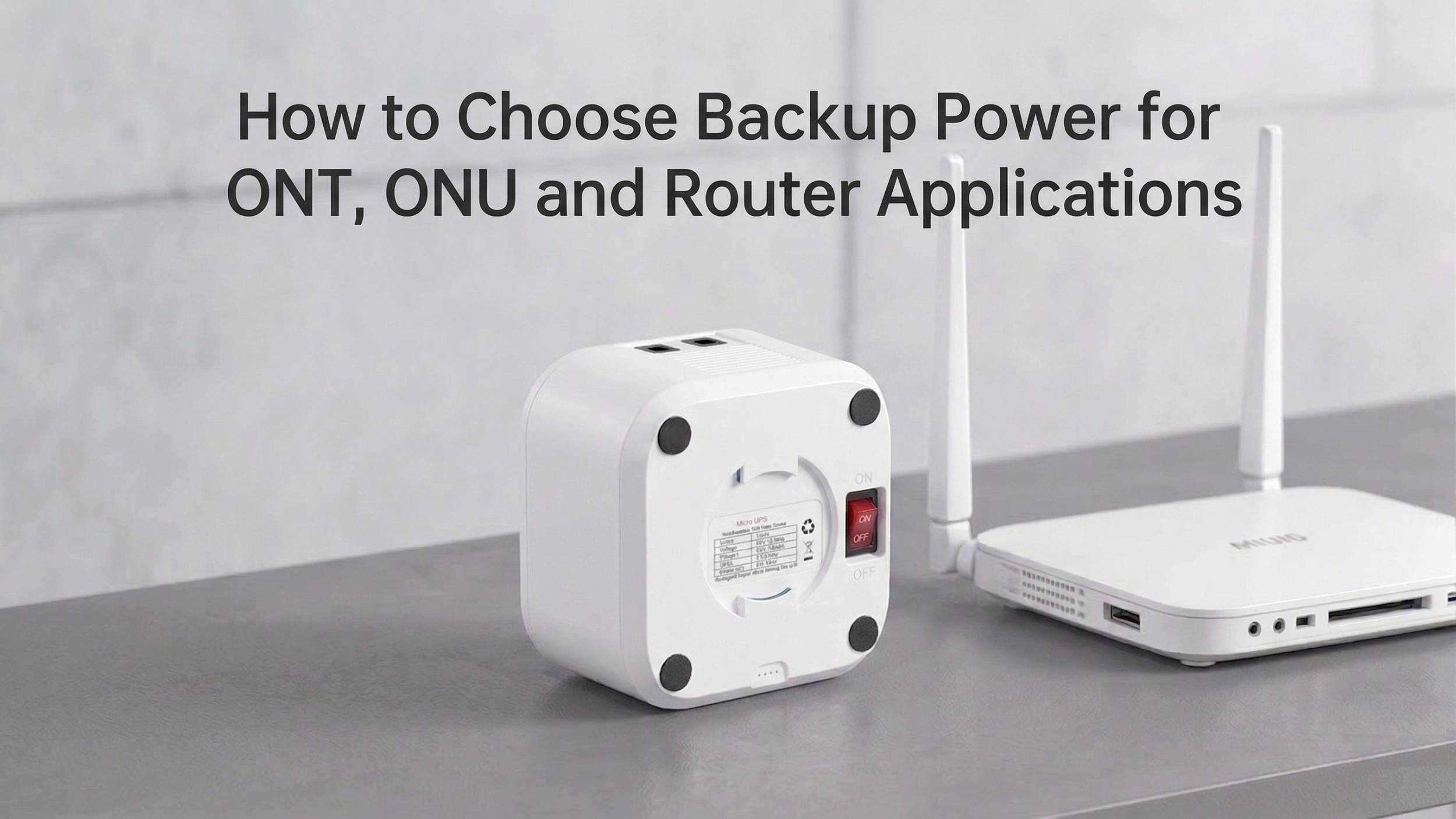
Backup runtime requirements vary based on deployment environment and typical power interruption patterns. In regions with brief, frequent outages, 1-2 hour runtime may suffice to bridge most events. In areas with extended outages, longer battery capacity becomes necessary, though practical and cost constraints typically limit customer-side backup to several hours rather than full-day capability.
Market Validation and Deployment Experience
MYLION’s backup power solutions have been deployed across international markets including Europe, North America, Latin America, Africa, the Middle East, and Asia, supporting telecom operators, ISPs, and broadband providers in diverse power environments. The company’s engineering-driven approach focuses on real-world deployment requirements rather than generic product supply, supporting customers through requirement analysis, model selection, sample testing, technical confirmation, and mass production delivery.
For FTTH operators, the business case for backup power deployment balances upfront equipment cost against reduced support calls, lower truck roll expenses, improved customer satisfaction scores, and decreased churn risk. Providers in power-challenged regions often find backup power deployment delivers positive return on investment within the first year through support cost reduction alone, even before accounting for customer retention benefits.
Conclusion: Power Resilience as Service Differentiation
Power interruptions represent a fundamental challenge to FTTH customer experience, creating service disruptions that generate complaints, increase support costs, and threaten customer retention. While ISPs cannot control local electrical infrastructure, they can mitigate customer-side impact through strategic deployment of appropriate DC backup power solutions matched to specific network equipment requirements.
Specialized providers like Shanghai Mylion New Energy Co., Ltd. offer engineering expertise and product ranges specifically designed for telecom and ISP applications, moving beyond generic UPS products to deliver solutions optimized for voltage compatibility, current capacity, connector matching, compact deployment, and project-based customization. As FTTH networks continue expanding globally, particularly in regions with challenging power infrastructure, backup power capability increasingly becomes a service differentiator that separates providers committed to true reliability from those offering fiber connectivity that remains vulnerable to local power conditions.
http://www.myliontech.com
Shanghai Mylion New Energy Co.,Ltd. -
AuthorPosts

- You must be logged in to reply to this topic.