- This topic is empty.
-
AuthorPosts
-
28/08/2026 at 21:08 #82131
Football stadium lighting is far more than simply “making it bright”. A successful international football match relies on a sophisticated set of optical performance indicators. Every detail – from players clearly seeing the ball, to smooth broadcast pictures, to spectators not being dazzled – corresponds to specific lighting parameters.
This article explains the six core technical metrics for football field lighting, based on the current Chinese industry standard JGJ 153-2016 Standard for Lighting Design and Testing of Sports Venues (China’s national standard for sports building lighting design) and the Chinese national recommended standard GB/T 38539-2020 Technical Requirements for LED Sports Lighting Applications. It should be noted that while China’s national standards reference FIFA and European (EN) standards in many respects, they have their own specific value ranges and grading systems. This article uses the Chinese standards as its primary reference.
1. Average Horizontal Illuminance – The Foundation for Athletic Performance
Horizontal illuminance (Eh) is the amount of light incident on the pitch’s horizontal plane, measured in lux (lx). It determines whether players can clearly see the ball, their teammates’ positions, and opponents’ movements. Too low, and ball trajectory becomes hard to track, slowing reaction times; too high, and energy is wasted.
The Chinese standard JGJ 153-2016 classifies football field lighting into different levels:
Level I (fitness, amateur training): Eh ≥ 200 lx
Level II (amateur matches, professional training): Eh ≥ 300 lx
Level III (professional matches): Eh ≥ 500 lx
FIFA elite events and 4K ultra HD broadcasting require an average horizontal illuminance of ≥ 2000 lx – four times the level required for professional matches.
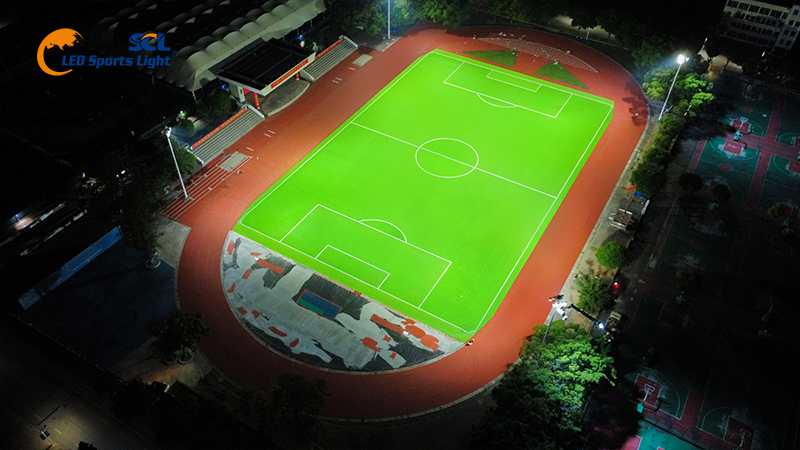
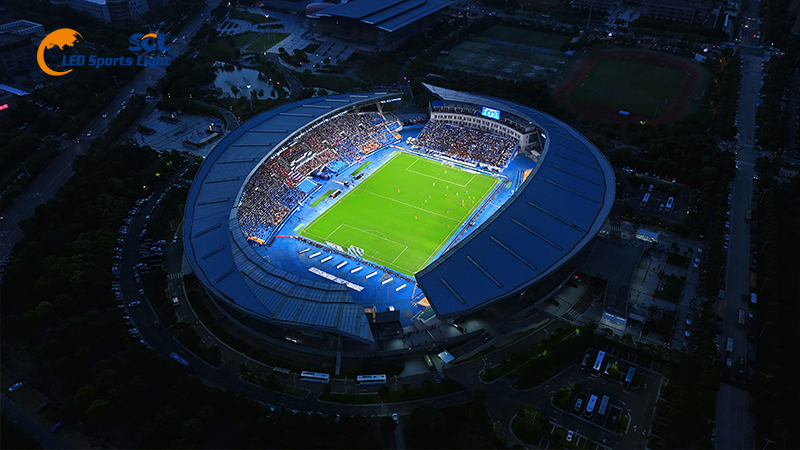
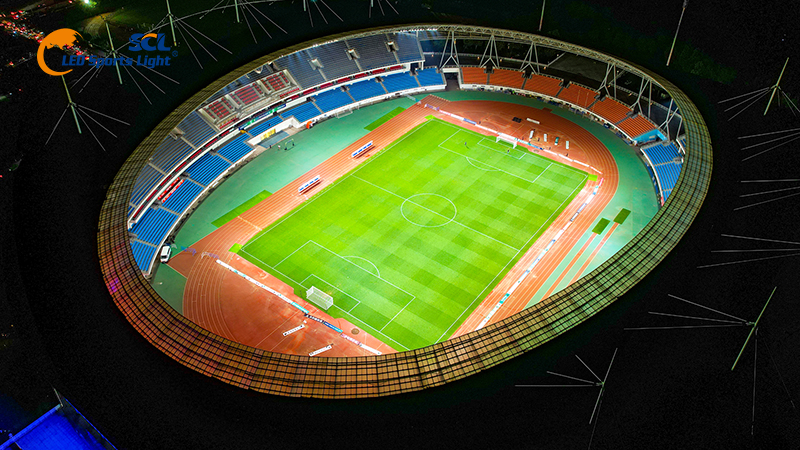
SCL Sports Lighting case study: As one of the drafting units for the Chinese national standard Technical Requirements for LED Sports Lighting Applications, SCL custom designed an LED football lighting solution for the Xiamen Sports Center Stadium in China, raising it to the TV broadcast level for national and international matches in terms of average horizontal illuminance. SCL’s technologies have also been successfully deployed in major events hosted in China – including the Universiade, Asian Games, and Chinese National Games – as well as in FIFA World Cup qualifiers, the Africa Cup of Nations, and the UEFA Europa League.
2. Vertical Illuminance – The Decisive Factor for Broadcast Picture Quality
Vertical illuminance (Ev) is the illuminance received on a vertical plane, representing light falling onto players’ faces and bodies. It directly affects the clarity of facial expressions, body contours, and shirt numbers in television broadcasts.
The Chinese standard JGJ 153-2016 specifies vertical illuminance requirements:
Level IV (TV broadcast for national and international matches): Ev ≥ 1000 lx
Level V (HDTV broadcast for major international matches): Ev ≥ 1400 lx
Level VI (HDTV broadcast for major international matches): Ev ≥ 2000 lx
For TV broadcasts, the ratio of average horizontal illuminance to average vertical illuminance should be between 0.75 and 1.80. At each calculation point, the ratio of the minimum to the maximum vertical illuminance in the four directions shall not be less than 0.3; for HDTV broadcasts of major events, it shall not be less than 0.6.
Insufficient vertical illuminance makes it difficult to discern critical details such as handballs or offside positions in slow motion replays; uneven distribution causes brightness jumps across different areas of the broadcast picture.
SCL Sports Lighting case study: Using TIR (total internal reflection) optical technology for precise light distribution, combined with high-colour-rendering (CRI ≥ 90) professional light sources, SCL ensures uniform projection without dark areas, fully meeting TV broadcast requirements for both main and auxiliary camera vertical illuminance. SCL also supplied professional LED sports lighting and a DMX intelligent control system to Brøndby IF of the Danish Superliga, with eight integrated lighting modes.
3. Illuminance Uniformity – Balancing Visual Comfort and Broadcast Stability
Illuminance uniformity measures the evenness of light distribution across the pitch. It is expressed by two indices:
U1 (minimum illuminance / maximum illuminance): reflects the extreme difference between the darkest and brightest areas.
U2 (minimum illuminance / average illuminance): reflects the overall dispersion of illuminance distribution.
The Chinese standard JGJ 153-2016 sets the following uniformity requirements for football fields:
Level
U1 (min/max)
U2 (min/avg)
Level III (professional matches)
≥ 0.4
≥ 0.6
Level IV and above (TV broadcast)
≥ 0.5
≥ 0.7
Poor uniformity creates obvious light and dark patches – bright in the centre, dark on the flanks – making it difficult for players to track the ball during fast movement, potentially leading referees to misjudge, and causing brightness fluctuations in broadcast pictures.
The Chinese standard also imposes stricter uniformity gradient requirements: for TV broadcasts, when the illuminance calculation/measurement grid spacing is less than 5 m, the illuminance change per 2 m shall not exceed 10%; when the grid spacing is 5 m or more, the change per 4 m shall not exceed 20%. This is more stringent than the MAUR (minimum adjacent uniformity ratio)指標 used by FIFA and the AFC.
SCL Sports Lighting case study: During the commissioning phase, SCL repeatedly adjusted the projection angles of luminaires to eliminate every low illuminance area, achieving uniformity that met live TV broadcast requirements while effectively controlling glare. SCL’s products and intelligent control systems are exported worldwide, with over 20 million sports enthusiasts exercising daily under SCL’s professional lighting environments.
4. Glare – The “Invisible Killer” for Players and Spectators
Glare is a visual condition caused by unsuitable brightness distribution, or extreme brightness contrast in space or time, that causes visual discomfort and reduces visibility. In simple terms, it means the lights are “dazzling”. On a football field, if a player heading the ball is dazzled by the lights, it can impair performance at best, and cause mistakes or even injury at worst.
In sports lighting, glare is measured by the GR (glare rating) . According to the Chinese standard JGJ 153-2016:
Outdoor football fields at professional match level: GR ≤ 50
Indoor arenas: GR ≤ 30
The level of glare is determined by luminous intensity, luminaire angle, and ambient brightness. Reducing glare requires an integrated optical design approach – using anti glare lenses, precise shielding angle control, appropriate luminaire mounting positions, and optimal aiming angles.
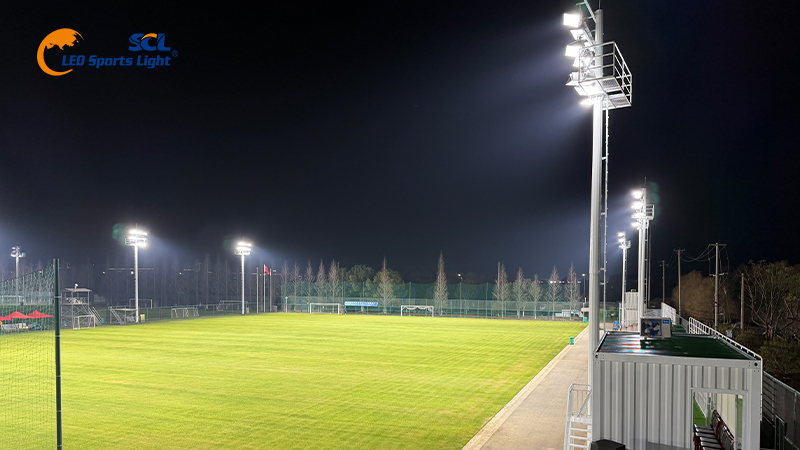
SCL Sports Lighting case study: SCL’s professional LED stadium lights use anti glare lenses developed jointly with a German laboratory, achieving a light transmittance above 98% and luminaire efficiency exceeding 95%. In projects such as the Asian Games football training grounds in China, SCL’s patented anti glare and anti spill light technology provided a healthier and more comfortable light environment for athletes.
5. Flicker – The “Picture Killer” in Slow-Motion Replays
Flicker refers to the periodic variation in luminous flux output from a light source. When matches are broadcast with slow motion or ultra slow motion replays, flicker can cause visible image instability. The more severe the flicker, the poorer the stability of slow motion footage.
Flicker is quantified by the flicker percentage (or percent flicker): the ratio of the difference between maximum and minimum light output to their sum, expressed as a percentage.
The Chinese standard JGJ 153-2016 specifies flicker limits:
HDTV broadcast of major matches (with super slow motion camera requirements): flicker percentage should not exceed 6%
High speed camera (≤ 1000 fps): flicker percentage ≤ 2%
A flicker percentage below 6% is considered slight and has minimal impact. Traditional metal‑halide lamps suffer from significant flicker due to AC mains frequency, whereas LED sport luminaires with high frequency PWM dimming (typically ≥ 20 kHz) can effectively keep flicker percentages extremely low.
Another major advantage of LED sport lights over metal‑halide lamps is instantaneous start – metal‑halide lamps require 5–15 minutes of warm up, while LED sport lights turn on immediately. This is critical for modern venues that need to switch quickly between training, matches, TV broadcast, and other scenarios.
6. Colour Temperature and Colour Rendering – The Core of True Colour Reproduction
Colour temperature (CCT) , measured in kelvin (K), determines the “warm” or “cool” feel of the light. For football broadcasts, to avoid image quality changes when switching from natural sunlight to artificial lighting, the artificial light source should have a colour temperature close to that of daylight.
The Chinese standard JGJ 153-2016 specifies a colour temperature range of 4000 K to 5500 K for different levels of football events. The Chinese Football Association professional league requires a colour temperature greater than 4200 K. International events (such as FIFA and UEFA) typically require 5000 K to 6200 K.
Colour Rendering Index (CRI) measures how accurately a light source reproduces the true colours of objects. The general colour rendering index Ra is the average of the CRI values for the first eight standard colour samples specified by the CIE. For television broadcasts, additional attention should be paid to R9 (saturated red colour rendering) and the TLCI (Television Lighting Consistency Index) .
The Chinese standard JGJ 153-2016 sets the following CRI requirements:
Football events with TV broadcast: general colour rendering index Ra ≥ 80, for LED sport lights luminaires R9 ≥ 0
HD / ultra HD TV broadcast: CRI ≥ 90 is recommended
In addition, the on-site colour temperature deviation from the rated colour temperature of the light source should not exceed 10%, and the on site colour rendering index should not fall below 10% of the rated value.
SCL Sports Lighting case study: SCL supplies professional light sources with high colour rendering (CRI ≥ 90), to faithfully reproduce turf and jersey colours Its RGBW full-colour light-show system and intelligent control system, fully and holding Chinese software copyrights, precisely control red, green, blue, and white light to create thousands of colour combinations. Together with the intelligent control system, it enables instantaneous start, constant illuminance maintenance, and flexible adjustment for training, matches, TV broadcasting, light shows, and other scenarios.
Conclusion
The six core lighting metrics – horizontal illuminance, vertical illuminance, uniformity, glare, flicker, colour temperature, and colour rendering – together form a complete
https://www.stadiumlight.com/
GUANGDONG SEVEN CONTINENTS INDUSTRIAL CO., LTD -
AuthorPosts

- You must be logged in to reply to this topic.