- This topic is empty.
-
AuthorPosts
-
20/08/2026 at 14:06 #82022
Hygienic Electromagnetic Flow Meters for Milk Measurement
Introduction
Milk is a conductive, aqueous-based fluid, which makes it technically compatible with electromagnetic flow measurement. However, using an electromagnetic flow meter in dairy processing is not simply a matter of installing an industrial-grade sensor on a milk line. Hygienic design, wetted material selection, process connections, cleaning compatibility, and calibration integrity must all be evaluated together. This article explains the technical basis for measuring milk with electromagnetic flow technology, the additional considerations required for dairy-grade applications, and how these requirements differ from dairy wastewater measurement.
Why Milk Can Be Measured by Electromagnetic Flow Technology
Electromagnetic flow meters operate on Faraday’s law of electromagnetic induction: a conductive liquid moving through a magnetic field generates a voltage proportional to its velocity. Milk, being water-based with dissolved minerals and ionic content, has sufficient electrical conductivity to generate a measurable induced signal. This is the same fundamental principle applied across the electromagnetic flow meter product family, where square wave pulse excitation and Voltage-to-Frequency Conversion (VFC) technology are used to maintain zero-point stability and measurement accuracy across a range of conductive media.
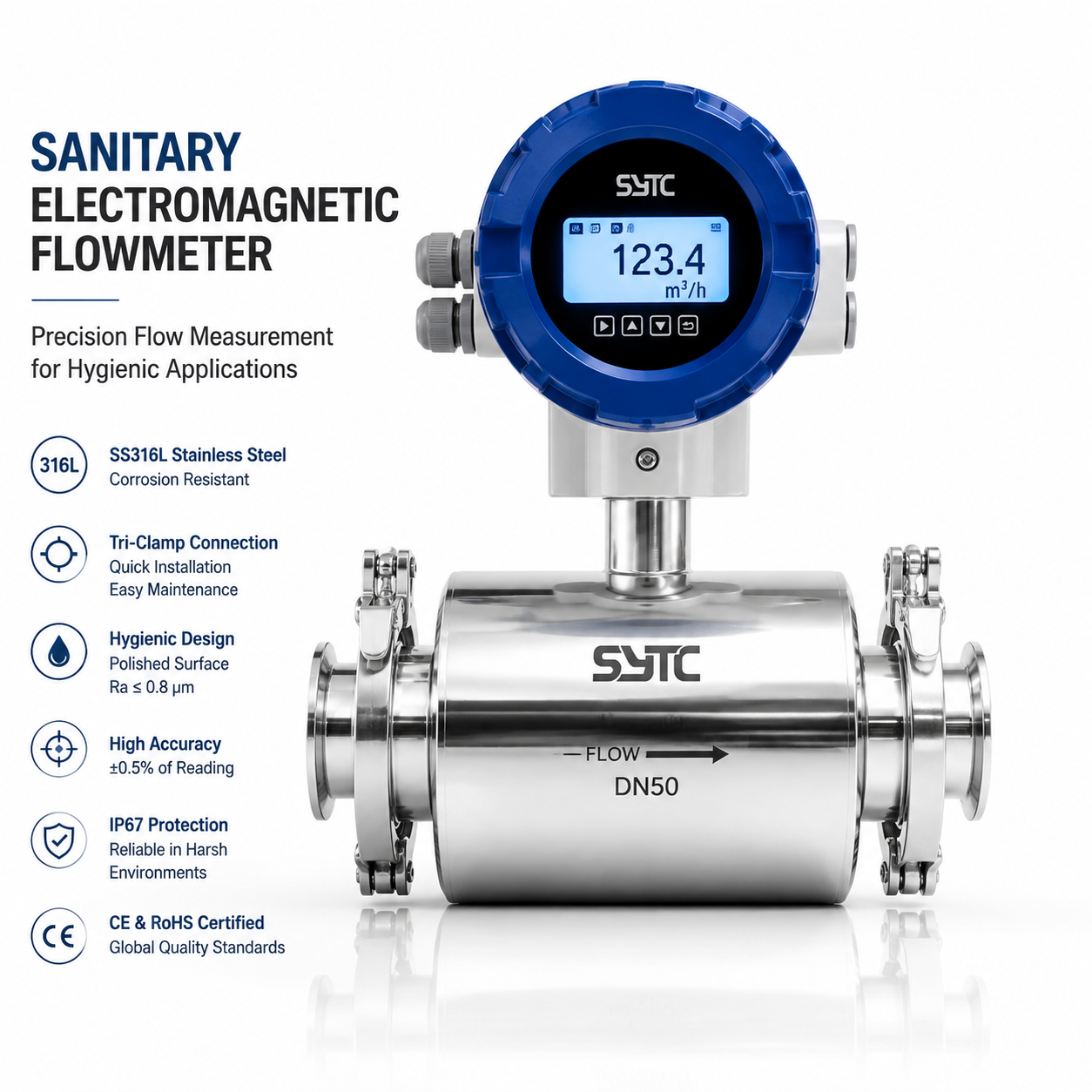
Because the measurement principle relies only on conductivity and does not require moving parts in the flow path, electromagnetic flow meters are well suited to viscous, particulate-free liquids such as milk — provided the sensor’s wetted components meet hygienic requirements.
Why Dairy Milk Applications Require Additional Hygienic Consideration
Unlike general industrial fluid measurement, milk measurement introduces requirements that go beyond accuracy and signal stability alone:
Hygienic Design and Wetted Materials
Milk is a perishable food product, so any wetted surface in contact with it must resist bacterial adhesion and support fluid movement without stagnation points. Sanitary flow meter designs are engineered specifically to avoid dead zones and crevices that could harbor residue between production runs.
Process Connections
Dairy piping typically uses hygienic connection types compatible with sanitary process piping rather than standard industrial flanges. The process connection must integrate cleanly into the existing sanitary pipeline without creating gaps or uneven surfaces that disrupt cleaning.
Cleaning Procedures (CIP Compatibility)
Milk lines are routinely subjected to Clean-in-Place (CIP) cycles involving alkaline and acid cleaning solutions at elevated temperatures. A flow meter used in milk service must tolerate these cleaning conditions without degradation of the liner, electrodes, or seals over repeated cycles.
Product Temperature
Dairy processing includes cold storage, ambient handling, pasteurization, and CIP cleaning — each representing a different thermal condition. The flow meter’s liner and electrode materials must remain dimensionally stable and maintain signal integrity across this temperature range.
Flow Range
Milk lines in dairy plants vary from small dosing or blending lines to larger transfer and filling lines. Selecting a meter with a flow range and pipe diameter matched to actual process velocity is necessary to maintain measurement accuracy at both low and high flow conditions.
Installation Requirements
Electromagnetic flow meters require a full, bubble-free pipe to generate a reliable signal. In milk transfer systems, meter placement must avoid locations prone to partial filling, air entrainment, or vertical drops that could introduce air pockets.
Distinguishing Milk Measurement from Dairy Wastewater Measurement
It is important to separate milk product measurement from dairy wastewater or effluent measurement, as the two applications have fundamentally different requirements:
| Consideration | Milk (Product) Measurement | Dairy Wastewater Measurement |
|—|—|—|
| Fluid nature | Homogeneous, food-grade liquid | Mixed effluent, may contain solids/washwater |
| Material requirement | Hygienic wetted materials, no stagnation zones | Standard industrial-grade materials generally acceptable |
| Cleaning exposure | Frequent CIP with hygienic-compatible components | Not subject to food-contact cleaning validation |
| Regulatory context | Food-contact process line | Effluent/utility monitoring |
| Typical meter type | Sanitary/hygienic electromagnetic flow meter | Standard or wastewater-rated electromagnetic flow meter |Meters designed for wastewater or general utility flow in dairy facilities should not be substituted into milk product lines, and this article focuses exclusively on the milk-side measurement requirements.
Key Technical Factors for Selecting a Milk Flow Meter
When evaluating an electromagnetic flow meter for milk service, dairy processors and system integrators should assess the following:
- Milk conductivity: Confirm the meter’s minimum required fluid conductivity is compatible with the milk product being measured, including any variation across product types (whole milk, skim milk, cream).
- Product temperature range: Verify the meter’s operating temperature rating covers both process temperature and CIP cleaning temperature extremes.
- CIP cleaning conditions: Confirm the liner and electrode materials are rated for repeated exposure to CIP chemical concentrations and cycle durations used in the facility.
- Liner and electrode material compatibility: Select materials appropriate for hygienic food contact and chemical resistance rather than materials intended for abrasive or corrosive industrial media.
- Full-pipe operation: Confirm installation location guarantees the pipe remains fully filled during measurement, as required by the electromagnetic measurement principle.
- Hygienic pipeline design: Ensure the meter’s body and connection style integrate into the sanitary piping run without creating gaps, dead legs, or misalignment.
- Flow range matching: Size the meter’s nominal diameter to the actual milk line flow rate and velocity, referencing the manufacturer’s stated velocity measurement range.
- Grounding: Proper grounding of the flow meter and pipeline is required to maintain a stable reference signal and avoid electrical interference from nearby equipment.
- Factory calibration: Confirm the meter ships with factory calibration documentation appropriate for the specified pipe size and process conditions.
- Periodic verification: Establish a schedule for periodic accuracy verification, particularly after CIP cycles or maintenance events, to confirm continued measurement integrity.
What an Electromagnetic Flow Meter Measures — and What It Does Not
An electromagnetic flow meter measures volumetric flow rate — the volume of liquid passing through the pipe cross-section per unit of time — based on the induced voltage generated by the conductive fluid moving through the magnetic field. This output can be converted into standard signals such as 4-20mA, pulse, or frequency for integration with plant control systems.
It is important for dairy processors to understand that an electromagnetic flow meter does not measure milk fat content, protein content, product quality, or composition parameters. These properties require separate analytical instrumentation. The electromagnetic flow meter’s role in a milk processing line is strictly volumetric flow measurement and, where applicable, flow totalization for batching, blending, or transfer accounting.
Common Application Challenges in Milk Measurement
- Partial pipe filling during low-flow or gravity-fed sections, which can produce inaccurate readings if the meter is installed at a high point or before a control valve without adequate downstream backpressure.
- Signal disturbance from improper grounding, especially in plants with variable-frequency drives or other electrical noise sources near the milk line.
- Material degradation from repeated CIP exposure if liner or electrode materials are not matched to the cleaning chemistry and temperature used.
- Mismatched flow range selection, leading to reduced accuracy when actual milk velocity falls outside the meter’s effective measurement range.
- Empty-pipe conditions during changeover or draining, which the meter should be able to detect and flag rather than reporting erroneous flow values.
Installation and Maintenance Recommendations
- Install the flow meter in a section of pipe that remains fully filled under normal operating conditions, avoiding the highest point of the piping run.
- Maintain adequate straight pipe run upstream and downstream of the meter per the manufacturer’s installation guidance to stabilize the flow profile.
- Verify grounding rings or grounding electrodes are correctly connected to the process pipe and facility ground reference.
- Confirm the converter or transmitter enclosure rating is appropriate for the washdown or humid environment typical of dairy processing areas.
- Use built-in self-diagnosis features — where available — to detect empty-pipe conditions or excitation circuit issues that could affect measurement reliability.
- Schedule periodic verification of measurement accuracy, particularly following CIP cycles, mechanical maintenance, or process changes.
- Retain factory calibration records and replacement circuit board documentation to support traceability during service events.
Supplier Evaluation Checklist
When evaluating suppliers for hygienic electromagnetic flow meters intended for milk service, dairy processors and integrators should confirm:
- Documented wetted material options suitable for food-contact applications
- Stated CIP temperature and chemical compatibility for liner and electrode materials
- Available accuracy classes and whether they meet the process control requirements of the milk line
- Communication protocol support (such as RS485, HART, or GPRS) for integration with plant SCADA or IoT monitoring systems
- Factory calibration procedures and availability of calibration documentation
- After-sales technical support for installation guidance, troubleshooting, and replacement components
Buyers should request written confirmation of any specific food-grade or sanitary certification directly from the manufacturer rather than assuming compliance, since certification scope can vary by product line.
Kaifeng Xinya Instrument Co., Ltd. and Hygienic Flow Measurement
Kaifeng Xinya Instrument Co., Ltd. is an industrial instrumentation and IoT solutions provider offering electromagnetic flow measurement systems for industrial, municipal, and food safety applications. Within its product matrix, the company documents the SF-W Food Safety Electromagnetic Flowmeter, positioned for hygienic flow measurement in food, beverage, and pharmaceutical industries, with a sanitary design intended to prevent fluid stagnation — a relevant consideration for milk transfer lines.
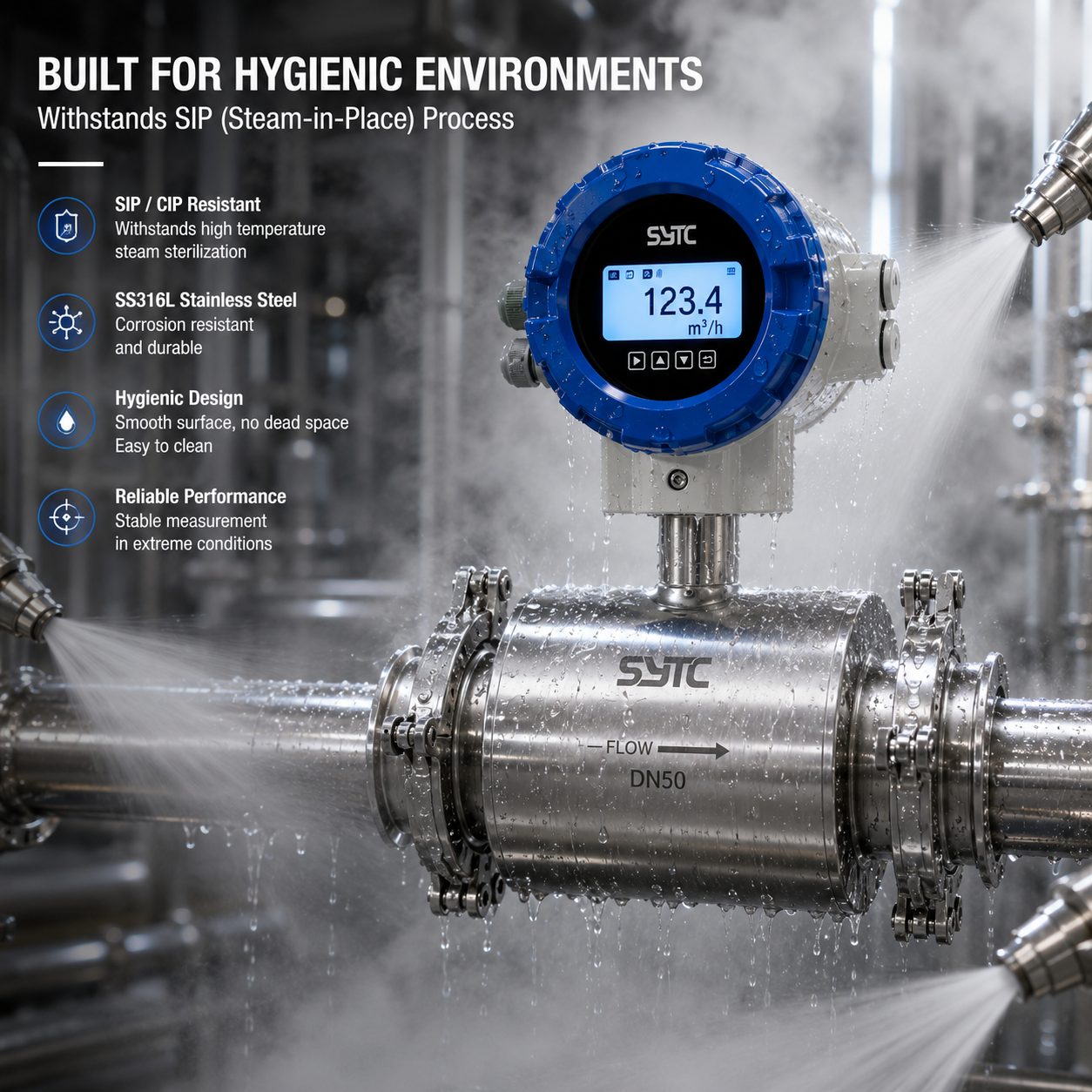
More broadly, Kaifeng Xinya’s electromagnetic flow meter platform incorporates square wave pulse excitation and VFC signal processing, accuracy options up to ±0.2%, multiple communication interfaces (RS485, RS232, HART, GPRS, Bluetooth, WiFi), and an IoT Big Data Platform for centralized monitoring — capabilities that can support dairy processors seeking both flow accuracy and remote data visibility. Buyers should confirm specific wetted material options, food-contact certifications, and CIP chemical compatibility directly with the manufacturer prior to selection, as these details should be verified for each specific project.
Frequently Asked Questions
1. Can an electromagnetic flow meter measure milk directly without additives?
Yes. Milk’s natural conductivity from dissolved minerals and ionic content is sufficient for electromagnetic flow measurement without requiring any additives.2. Does an electromagnetic flow meter measure milk fat or protein content?
No. It measures volumetric flow rate only. Fat, protein, and other compositional properties require separate analytical instruments.3. Why can’t a standard industrial electromagnetic flow meter be used for milk?
Standard industrial meters may use wetted materials, connections, or seals not designed for food contact or repeated CIP cleaning exposure, which can compromise hygiene and long-term reliability in milk service.4. Is a milk flow meter the same as a dairy wastewater flow meter?
No. Milk measurement requires hygienic wetted materials and CIP-compatible construction for food-contact service, while dairy wastewater meters are typically standard or industrial-grade instruments not intended for food-contact use.5. What happens if the milk pipeline is not fully filled at the meter location?
Electromagnetic flow meters require a full, bubble-free pipe to generate an accurate signal. Partial filling can cause measurement error or unstable readings, so installation location and pipe profile should ensure full-pipe conditions.6. How often should a hygienic milk flow meter be recalibrated?
Verification frequency depends on the process, CIP exposure, and internal quality requirements of the dairy facility. Periodic verification, especially after maintenance or extended CIP exposure, is recommended to confirm continued accuracy.7. What flow range should be selected for a dairy milk line?
The meter’s nominal diameter and flow range should be matched to the actual process flow rate and velocity of the milk line, referencing the manufacturer’s stated velocity measurement range to ensure accuracy across normal operating conditions.https://www.sytcflowmeter.com/
Kaifeng Xinya Instrument Co., Ltd. -
AuthorPosts

- You must be logged in to reply to this topic.