- This topic is empty.
-
AuthorPosts
-
27/05/2026 at 09:55 #81336
As industrial IoT deployments scale globally, network reliability has emerged as the defining factor between project success and costly failure. Industry research reveals that 68% of industrial IoT implementations encounter critical connectivity issues, with network instability, equipment failures in extreme conditions, and excessive maintenance costs topping the list of concerns. For enterprises managing distributed, unattended infrastructure—from remote power substations to mobile transportation networks—the question is no longer whether to adopt 5G, but how to ensure that connectivity remains uninterrupted when business operations depend on it.
The Hidden Cost of Network Downtime in Industrial Environments
Traditional consumer-grade routers, even those marketed with 5G capabilities, consistently fail in industrial settings. When a payment terminal loses connection during peak transaction hours, or when a remote environmental monitoring station goes offline during a critical weather event, the financial and operational consequences cascade rapidly. A single disconnection event can trigger service level agreement penalties, emergency site visits, and potential safety incidents.
The root cause extends beyond simple hardware specifications. Industrial environments present challenges that consumer electronics were never designed to handle: voltage fluctuations from unstable power grids, electromagnetic interference from heavy machinery, temperature extremes ranging from arctic cold to desert heat, and physical shock from vehicular mounting or outdoor exposure. Equipment that performs reliably in climate-controlled offices becomes a liability when deployed on airport aprons, inside utility substations, or mounted to municipal vehicles.
Why Dual SIM Architecture Matters for Mission-Critical Operations
Dual SIM functionality represents more than redundancy—it embodies a fundamental shift in network architecture philosophy. Rather than treating connectivity as a single-threaded dependency, dual SIM hot backup systems continuously monitor primary network health and execute automatic failover within seconds when degradation occurs. This architecture proves essential across multiple scenarios:
Geographic coverage gaps: In regions where Carrier A provides strong urban coverage but Carrier B dominates rural areas, dual SIM routers automatically select the optimal network based on real-time signal quality.
Carrier-specific outages: When network maintenance, equipment failures, or capacity constraints affect one provider, the secondary SIM maintains business continuity without human intervention.
Load balancing and cost optimization: Organizations can route high-volume data through one carrier while preserving a second connection for critical command-and-control traffic, optimizing both performance and data plan costs.
For industrial deployments spanning multiple countries or regions, dual SIM capability becomes even more critical. A transportation company operating cross-border routes, for instance, cannot afford connectivity gaps at national boundaries where carrier coverage areas terminate.
Engineering for Reliability: What Industrial-Grade Actually Means
The distinction between consumer and industrial networking hardware manifests across multiple engineering dimensions. E-Lins Technology has built its reputation over 20 years specifically on understanding these distinctions and translating them into commercially validated products.
Thermal management: The H900f Gigabit 5G Industrial Router maintains stable operation across a -35°C to +75°C temperature range, addressing the reality that equipment cannot always be housed in climate-controlled environments. This wide temperature tolerance stems from component selection—using industrial-grade chips rather than consumer variants—and thermal design that accounts for heat dissipation in enclosed spaces.
Electrical protection: With 15KV ESD protection and 1.5KV electromagnetic isolation, industrial routers survive the electrical noise generated by motor controllers, welding equipment, and power conversion systems that would destroy standard networking gear. ISO 7637-2 compliance for vehicle installations further ensures survival of ignition transients and other automotive electrical events.
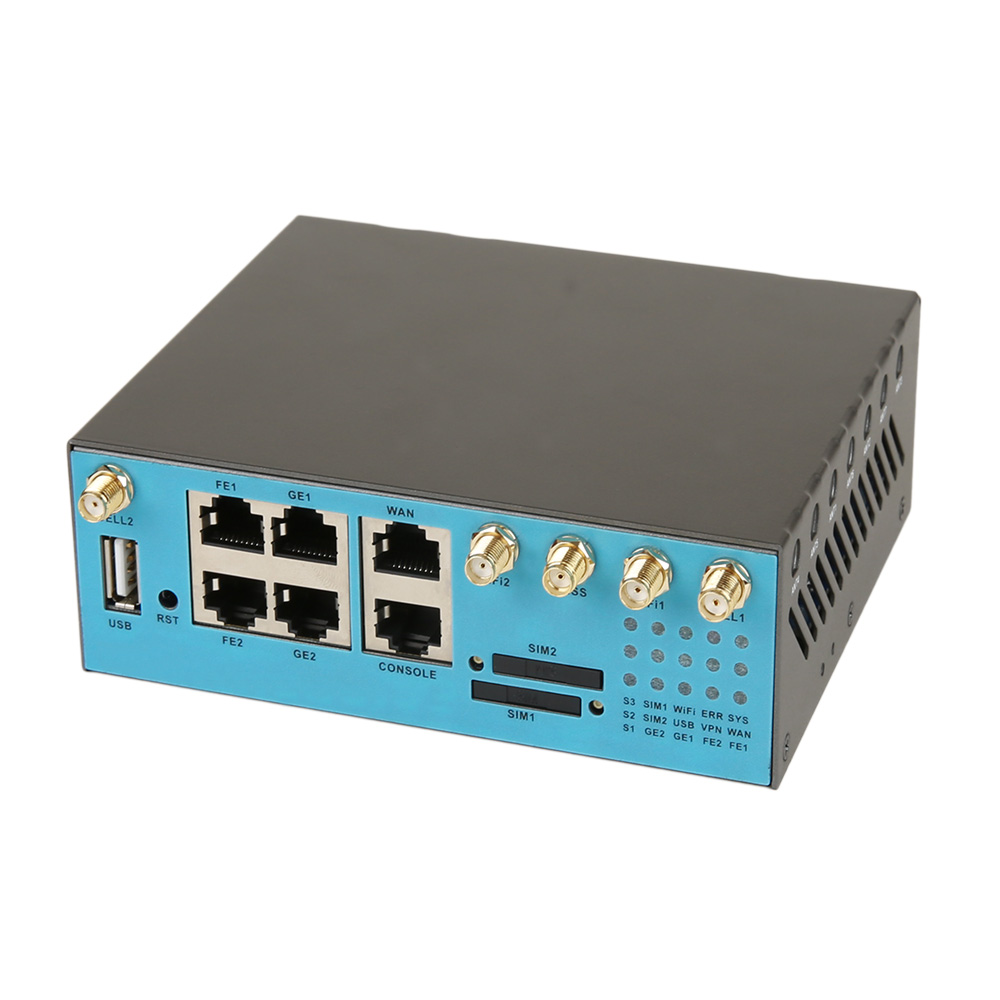
Mechanical durability: IP68-rated enclosures, such as those employed in the H820QO Outdoor Router, enable direct pole mounting without additional protective shelters, reducing installation costs while maintaining equipment integrity against dust, moisture, and physical impact.
These specifications translate directly to business outcomes. When a leading Indian telecom operator deployed E-Lins equipment across base stations experiencing unstable power conditions (5V-55V fluctuations) and extreme heat (48°C ambient temperatures), the infrastructure achieved a 99.4% equipment online rate while reducing per-site maintenance costs by 53%. Across 100,000 deployed units, batch management efficiency improved by 82%, demonstrating that industrial-grade engineering delivers measurable operational value at scale.
5G Performance Without Compromise: Bandwidth Meets Reliability
The transition from 4G to 5G in industrial applications unlocks qualitatively different use cases. High-definition video surveillance, real-time telemetry from distributed sensors, and edge computing workloads all demand both high bandwidth and low latency. However, these performance characteristics prove meaningless if connectivity itself remains unreliable.
The H900f addresses this challenge through several architectural decisions. 5G SA/NSA dual-mode support ensures compatibility with both current Non-Standalone networks (which use existing 4G infrastructure for control signaling) and future Standalone networks (which deliver true 5G architecture benefits). This future-proofing protects infrastructure investments as carriers complete their network modernization programs.
Gigabit Ethernet interfaces with 2.5Gbps capability ensure that wired network segments don’t become bottlenecks when wireless throughput reaches multi-hundred-megabit rates. For applications like 4K/8K video transmission from mobile platforms or real-time industrial automation protocols, this end-to-end bandwidth pathway proves essential.
PoE++ support adds another dimension of installation flexibility, enabling the router to power connected devices—cameras, sensors, or edge compute modules—through the same Ethernet cable that carries data. This simplifies installation in locations where separate power infrastructure would be costly or impractical to deploy.
Customization Beyond Configuration: OEM and Integration Capabilities
While standardized products address many industrial connectivity needs, large-scale deployments and specialized applications often require customization. E-Lins Technology’s two-decade history as an ODM/OEM manufacturing partner for global brands including Huawei, ZTE, Samsung, and LG demonstrates capabilities that extend beyond catalog products.
Custom firmware development, specialized interface configurations, and white-label manufacturing enable system integrators and equipment manufacturers to incorporate industrial 5G connectivity as a seamless component of their solutions. A European aviation ground support equipment manufacturer, serving airports across 100+ countries, leveraged this customization capability to integrate E-Lins connectivity into aircraft ground power and air conditioning monitoring systems. The resulting implementation achieved a ≥99.9% equipment online rate while reducing on-site maintenance costs by 68%, with 85% of issues now resolved remotely through the 4G/VPN connectivity layer.
Security Architecture for Industrial Networks
As industrial systems become increasingly connected, cybersecurity transitions from IT concern to operational imperative. Industrial control systems, payment terminals, and critical infrastructure monitoring platforms cannot tolerate the security vulnerabilities that plague consumer IoT devices.
E-Lins routers implement enterprise-grade VPN protocols including WireGuard, IPsec, and OpenVPN, providing encrypted tunnels that protect data in transit from interception or tampering. For a South American gaming equipment manufacturer managing 25,000 terminals across eight countries, this encryption capability proved essential for secure transaction data transmission in high-interference casino environments. The implementation achieved a 99.9% data transmission success rate with zero accounting disputes, while streamlining maintenance personnel from 25 to 7—generating approximately $1.18 million in annual savings.
The security architecture extends beyond encryption to include hardware-based watchdog timers, automatic firmware integrity verification, and remote management platforms that enable centralized security policy enforcement across distributed deployments. With 100% self-developed firmware rather than generic public Linux distributions, E-Lins maintains direct control over vulnerability patches and security updates, reducing the attack surface compared to systems built on third-party operating systems.
Total Cost of Ownership: Beyond Initial Hardware Price
Purchase price represents only one component of industrial networking total cost of ownership. Installation complexity, ongoing maintenance requirements, troubleshooting efficiency, and equipment lifespan all contribute to long-term economic outcomes.
The modular interface design employed across E-Lins product lines—combining Ethernet, Serial (RS232/485), and DI/DO in compact form factors like the H685f Mini Embedded Series—reduces integration complexity and improves installation efficiency by approximately 50%. When a Nordic intelligent transportation provider deployed these routers for in-vehicle networking and electronic stop displays across Sweden, Norway, and Denmark, the systems maintained operation through -32°C winters with a network interruption rate of just 0.3%. Information screen blackout duration decreased by 96%, while 90% of faults could be handled remotely, saving 62% in annual maintenance costs.
Remote management capabilities prove particularly valuable for distributed installations where on-site technical visits incur substantial travel time and expense. With 7×24-hour remote support, packet capture analysis, and over-the-air firmware updates, many connectivity issues that would traditionally require truck rolls can be diagnosed and resolved remotely. This operational model reduces maintenance costs by 40% on average while improving mean time to resolution.
Choosing Industrial Connectivity That Scales
As industrial IoT deployments mature from pilot projects to production infrastructure, the connectivity layer must scale not just in unit volume but in operational sophistication. The difference between 95% uptime and 99.5% uptime—the performance threshold that E-Lins equipment consistently achieves—represents the difference between constant firefighting and reliable operations.
For organizations evaluating dual SIM 5G router solutions, the decision framework should extend beyond specification sheets to examine manufacturing credibility, field validation scale, and customization capabilities. With over 150 countries served, cumulative supplies exceeding 100,000 units for individual carrier projects, and a customer satisfaction rate of 97%, E-Lins Technology demonstrates the operational maturity that mission-critical industrial deployments require.
Industrial connectivity is no longer a peripheral concern but a foundational infrastructure layer upon which digital transformation depends. Choosing solutions engineered specifically for industrial reliability, backed by decades of manufacturing expertise and validated through large-scale commercial deployments, represents the surest path to connectivity that simply works—even when business operations depend on it most.
https://e-lins.com/
Shenzhen E-Lins Technology Co., Ltd. -
AuthorPosts

- You must be logged in to reply to this topic.