- This topic is empty.
-
AuthorPosts
-
06/05/2026 at 18:50 #81213
When infrastructure projects demand ASTM A325-certified structural bolts, the margin for error disappears. A single batch of non-compliant fasteners can trigger inspection rejections, delay concrete pours, and expose contractors to liability claims. For project managers navigating highway expansions, bridge rehabilitations, or commercial steel framing, the choice of fastener supplier directly impacts schedule integrity and structural safety.
Understanding ASTM A325 Compliance in Real-World Applications
ASTM A325 structural bolts serve as the backbone of steel-to-steel connections in high-load environments. Unlike general-purpose fasteners, these heavy-duty bolts must meet stringent material composition, tensile strength, and dimensional tolerances defined in ASTM F3125 specifications—the updated standard consolidating previous A325 and A490 requirements. The challenge lies not merely in purchasing bolts stamped with certification marks, but in ensuring every component maintains structural integrity through manufacturing, coating, and final installation.
Infrastructure projects frequently encounter three critical pain points: extended lead times for non-standard configurations, galvanizing processes that compromise thread precision, and imported fasteners lacking traceable material test reports (MTRs). A specialized manufacturer addressing these issues demonstrates measurable advantages through end-to-end process control—from hot forging raw materials to applying protective coatings without outsourcing critical steps.
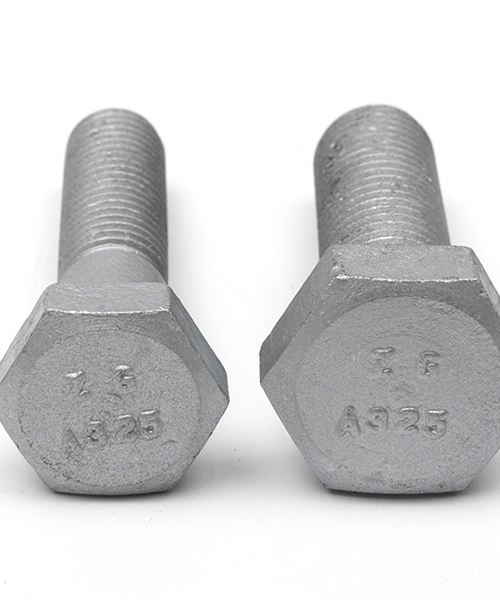
The Hidden Risk of Third-Party Galvanizing
Hot-dip galvanizing extends fastener service life in corrosive environments, yet the process introduces thread-fit complications when handled by external vendors. Standard industry practice involves shipping finished bolts to third-party galvanizers, where molten zinc coating accumulates in threaded sections. Without precise post-galvanizing treatment, nuts bind or cross-thread during installation—a defect often discovered only during field assembly.
Manufacturers operating in-house hot-dip galvanizing facilities eliminate this double-handling vulnerability. By controlling zinc bath chemistry and employing centrifugal spinning techniques, excess coating material is expelled from thread roots immediately after immersion. This ensures ASTM A325 bolts maintain Class 3 thread tolerances even after galvanizing, allowing nuts to spin freely without manual thread-chasing—a distinction that accelerates installation schedules and reduces field rework.
For structural steel fabricators working with high-strength A325 or A490 grades, galvanizing quality directly affects joint performance. When zinc thickness exceeds tolerance limits in the thread engagement zone, torque values become unreliable, potentially compromising the clamping force required for friction-type connections in seismic applications.
Material Traceability and Compliance Documentation
Infrastructure contracts increasingly mandate full material traceability, particularly for Department of Transportation projects and commercial developments subject to third-party engineering review. Every ASTM F3125-compliant bolt must be accompanied by certified material test reports (MTRs) documenting chemical composition, heat treatment records, and mechanical property testing results.
Specialized anchor bolt manufacturers with vertically integrated operations provide batch-specific MTRs that trace material lineage from steel mill certifications through final inspection. This documentation proves critical during structural plan reviews, where engineers verify that specified yield strengths—36 ksi for Grade 36, 55 ksi for Grade 55, or 105 ksi for Grade 105 in ASTM F1554 anchor bolts—match installed hardware. The absence of traceable documentation triggers compliance holds that delay certificate of occupancy approvals and final payment releases.
Custom Fabrication Capabilities for Non-Standard Requirements
Standard catalog bolts rarely accommodate the geometric complexities of modern infrastructure. Bridge retrofits demand custom bend radii in anchor bolts to navigate congested rebar cages. Historic timber structure restorations require square-head or dome-head bolts unavailable through distribution channels. Cell tower modifications need logo-embossed boltheads for permanent asset tracking.
Manufacturers equipped with proprietary hot forging capabilities for diameters ranging from 1/2″ to 2-1/2″ address these specifications without sourcing overseas. Five-axis CNC threading technology enables precision Class 3 threads on bent anchor bolts, maintaining dimensional accuracy despite complex geometries. Custom tooling programs allow architectural projects to specify unique head configurations—square, hexagonal, or decorative dome profiles—without the 12-week lead times typical of import sourcing.
This fabrication flexibility proves essential in foundation work, where 90-degree bent anchor bolts must conform to engineer-sealed drawings specifying exact leg lengths, thread projections, and bend radii. Concrete contractors facing imminent pour deadlines cannot absorb six-week production queues; specialized manufacturers responding within 7-10 business days prevent costly schedule slippage.
Precision Engineering for Load-Critical Applications
Structural bolts in seismic zones and wind-load environments function as calibrated mechanical devices, not commodity hardware. Heavy hex geometry in ASTM A325 bolts distributes clamping loads across larger bearing surfaces, preventing joint slip under cyclical loading. High-strength alloy compositions in A490 grades provide enhanced tensile capacity for moment connections in tall structures.
These performance characteristics depend on manufacturing precision. CNC threading ensures consistent thread pitch and flank angles across production runs, eliminating the dimensional variability common in roll-threaded imported fasteners. When structural engineers specify pretension values for slip-critical connections, field installation crews rely on predictable torque-tension relationships—a reliability compromised by inconsistent thread geometry or off-spec material hardness.
For heavy timber applications, specialized hardware like shear plates and split rings increases load transfer capacity in bolted wood joints. These malleable iron connectors, when paired with properly galvanized bolts, solve the joint weakness inherent in large-scale timber framing, particularly in bridge glulam beam assemblies and heavy timber trusses in commercial construction.
Market Validation Across Infrastructure Sectors
The value proposition of vertically integrated fastener manufacturing manifests across diverse project types. Highway signage and street lighting installations benefit from corrosion-resistant anchor bolts that withstand decades of salt spray exposure without thread degradation. Stadium and arena projects require high-volume deliveries of structural bolts with compressed schedules—scenarios where in-house galvanizing accelerates turnaround. Marine construction at docks and piers demands fasteners meeting both ASTM structural specifications and enhanced corrosion protection standards.
General contractors, steel fabricators, and structural engineers increasingly prioritize suppliers capable of providing single-source accountability—eliminating finger-pointing between bolt manufacturers, galvanizers, and distributors when field issues arise. This consolidated responsibility model reduces procurement complexity while ensuring consistent quality across project phases.
Strategic Advantages for Project Managers
Infrastructure project managers evaluating ASTM A325 suppliers should assess three differentiating capabilities: manufacturing control, galvanizing quality, and technical compliance documentation. Suppliers operating captive forging and coating facilities deliver faster lead times and superior thread fit compared to distributors outsourcing production steps. In-house metallurgical testing and quality control departments provide the compliance documentation required for engineer approval and DOT acceptance.
For projects specifying non-standard configurations—bent anchor bolts, custom head styles, or oversized diameters—fabrication flexibility determines schedule feasibility. Manufacturers with CNC machining capabilities and custom tooling programs convert engineered drawings into finished hardware within project timelines, eliminating the risk exposure associated with offshore sourcing.
Conclusion: Compliance, Speed, and Accountability
Selecting ASTM A325 structural bolts extends beyond comparing unit prices. The true cost calculation incorporates lead time impact on critical path activities, rework expenses from thread-fit failures, and liability exposure from non-compliant materials. Specialized manufacturers combining proprietary forging, precision threading, and in-house galvanizing deliver measurable project value through compressed schedules, predictable quality, and comprehensive compliance documentation—advantages that standard distribution channels cannot replicate.
For infrastructure project managers, the strategic decision lies in partnering with suppliers who control the complete manufacturing process, ensuring that every bolt delivered to the jobsite meets both specification requirements and installation realities.
Shanghai Hengrui Industrial Co., Ltd -
AuthorPosts

- You must be logged in to reply to this topic.