- This topic is empty.
-
AuthorPosts
-
27/04/2026 at 11:07 #81162
What if the fineness of lithium battery slurry cannot reach 100 nanometers? The advanced path from "grinding finely" to "stabilizing well"
In the preparation process of lithium batteries, the control of slurry fineness is a crucial step determining battery performance. When the D90 particle size cannot be stably controlled below 100 nanometers, it not only affects the uniformity of electrode coating, but also directly impacts the energy density, cycle life, and safety performance of the battery.
However, many enterprises face such a dilemma: the slurry just off the production line tests as qualified in fineness, but after being stored for a few hours, the particles quietly "grow larger". Behind this, there are two underlying mechanisms that determine the stability of the slurry – **Ostwald ripening** and **zeta potential imbalance**.
Ostwald ripening: "big fish eating small fish" of nanoparticles
Ostwald ripening describes a microscopic "swallowing" phenomenon in suspension systems. Due to the higher surface energy and solubility of small particles compared to large particles, they gradually dissolve and disappear, while the dissolved molecules re-precipitate on the surface of larger particles, leading to the growth of the larger particles.
For lithium battery slurry, this phenomenon is particularly severe when the initial particle size distribution is too wide. Even if the initial fineness reaches below 100 nanometers, due to the presence of extremely small particles, Ostwald ripening will continue to occur during storage or transportation, ultimately leading to increased particle size of the slurry, uneven coating, and even gelation.
To inhibit Ostwald ripening, the core lies in achieving an extremely narrow particle size distribution – without extremely small particles to dissolve or oversized particles to grow, thereby blocking the "merging" phenomenon at its root.
Zeta potential: The "invisible shield" between particles
If Ostwald ripening is attributed to the "chemical activity" of particles, then Zeta potential serves as the "physical repulsive force" between particles.
Zeta potential is a core indicator for characterizing the stability of colloidal systems, directly reflecting the charge state of the sliding surface of particles. When the absolute value of Zeta potential is higher, the electrostatic repulsion between particles is stronger, and the slurry is more stable; conversely, when the potential decreases, particles tend to re-agglomerate and settle under the influence of van der Waals forces.
For lithium battery slurry, the industry-accepted standard is: |ζ| > 35mV for a highly stable system, 30 ≤ |ζ| < 35mV for a stable system, and |ζ| < 20mV indicating a high risk of agglomeration. In nanoscale slurry systems, due to the significant increase in specific surface area, the regulation of zeta potential is particularly crucial.
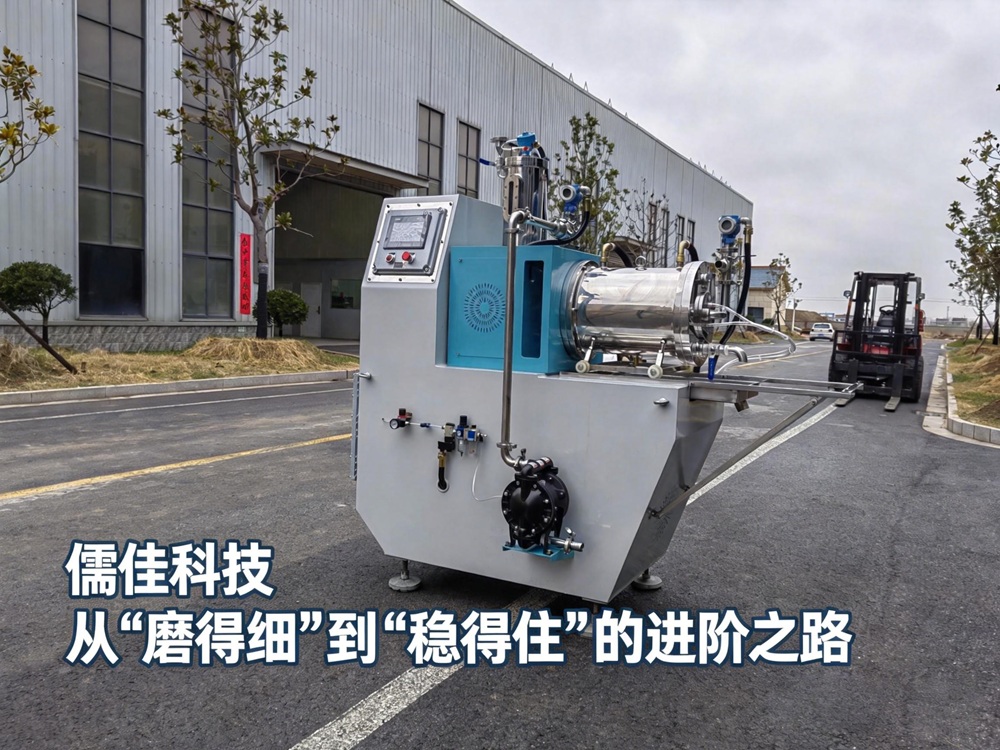
Rucca's bead mill solution: screenless centrifugal discharge + dual-loop intelligent temperature control
By understanding these underlying mechanisms, it is not difficult to see that a truly excellent grinding equipment must simultaneously address the two major challenges of "grinding finely" and "maintaining stability". Rucca has developed a proprietary technology system tailored to the special needs of lithium battery slurry:
**✅ Screen-free Centrifugal Discharge Technology**: Say goodbye to the traditional screen clogging troubles. Utilizing the dynamic centrifugal separation principle, the grinding medium is thrown back into the grinding chamber by centrifugal force, ensuring that only slurry with qualified particle sizes can flow out smoothly. This design fundamentally avoids medium contamination caused by screen damage, while ensuring a smooth discharge channel, providing hardware support for continuous and stable nanoscale grinding.
**✅ Dual-loop intelligent temperature control system**: Precisely controls temperature fluctuations during the grinding process. Due to the extremely high energy input in nanoscale grinding, improper temperature control can lead to sudden changes in slurry viscosity, dispersant failure, and a decrease in Zeta potential. Rucca's dual-loop design utilizes internal and external cooling channels to ensure that the dispersant can be uniformly adsorbed on the particle surface at an ideal temperature, forming a stable double-layer structure and maintaining sufficient Zeta potential.
**✅ Synergistic Effect**: When these two technologies work together, the effect is doubled – the screen-free design ensures continuous and stable grinding efficiency, while the dual-loop temperature control creates ideal conditions for the stability of Zeta potential. The combined effect of the two results in a narrower particle size distribution of the ground slurry, a higher Zeta potential, and better long-term stability.
The qualitative change from "being able to disperse" to "dispersing well"
The nanoscale preparation of lithium battery slurry is facing a qualitative change demand from "being able to disperse" to "dispersing well". When fineness is no longer a threshold, stability becomes the key to success.
Rucca has achieved the true meaning of "fine grinding and stable retention" by combining the technologies of screenless centrifugal discharge and dual-loop intelligent temperature control, which fundamentally inhibits austenite aging and creates ideal conditions for the stability of Zeta potential.
If you are struggling with the nano-scale grinding challenge of lithium battery slurry, welcome to Rucca Laboratory with your materials – let us speak with data and ensure the stability of your slurry.
http://www.ruccagroup.net
RUCCA bead mill -
AuthorPosts

- You must be logged in to reply to this topic.